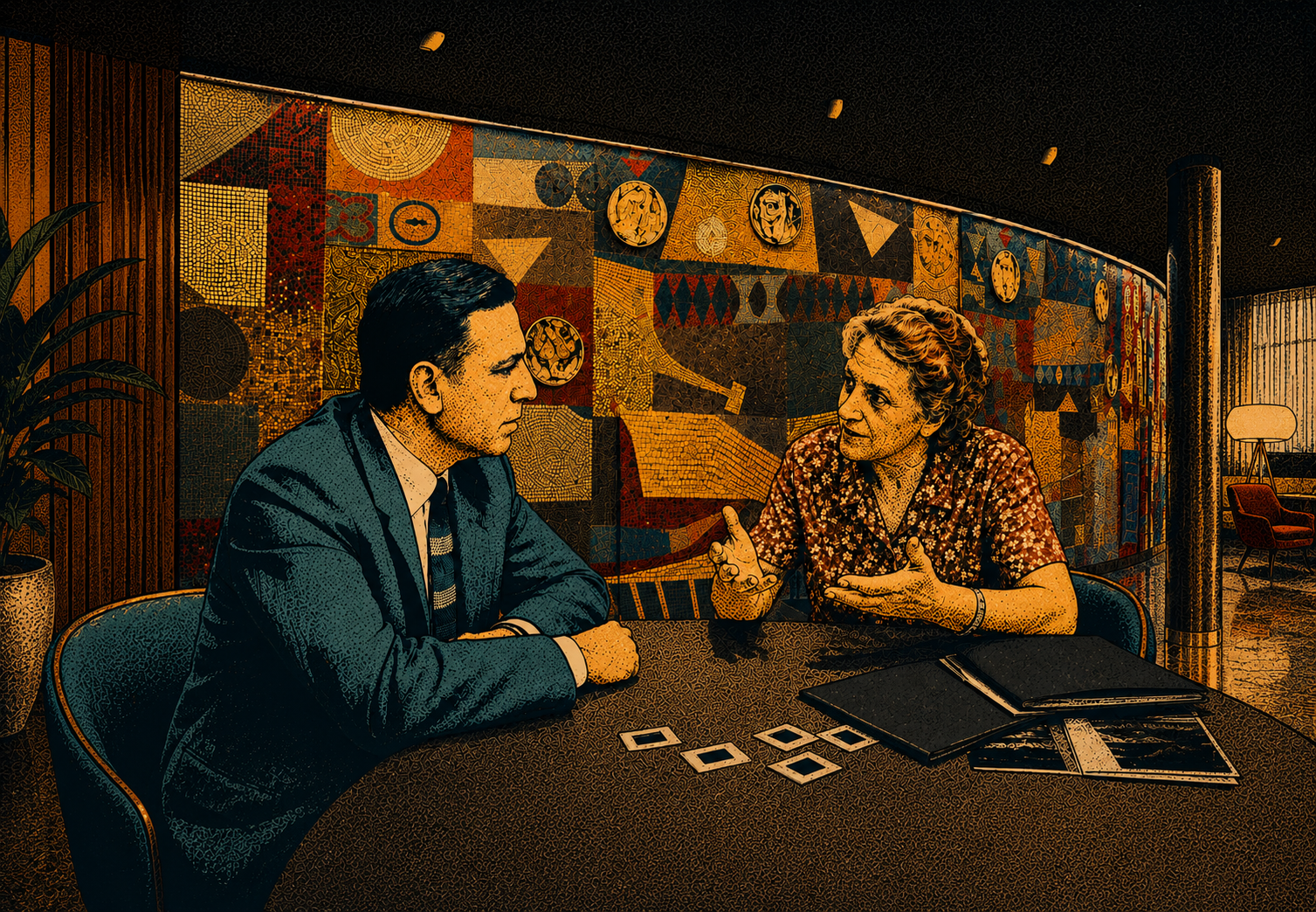
▲ Interpretive reconstruction of Pignataro’s 1976 meeting with Director Marta Grimberg at the Museo Municipal de Artes Visuales
In October of 1976, Argentine Informalist artist Roberto Pignataro met with Marta Grimberg, then Director of the Museo Municipal de Artes Visuales in Buenos Aires, to discuss the possibility of a solo exhibition. The proposal was met with enthusiasm, setting in motion plans for what would be Pignataro’s most extensive institutional presentation to date.
However, the project would soon encounter unexpected complications. This article reconstructs the initial meeting and the events that followed, tracing how a promising opportunity suddenly unraveled, giving rise to a series of situations shaped by broken promises, bureaucratic failure, and difficult ethical choices.
•••
Historical Context
Teatro General San Martín, which housed the Museo Municipal de Artes Visuales in 1976.
Photo: Estudio MRA+A
To understand how the organization of this exhibition unfolded, it is important to first consider the institutional context in which it took place.
The events occurred in the aftermath of Argentina’s 1976 military coup, a period during which public institutions across the country were undergoing significant restructuring.
Within this climate, the Buenos Aires museum system experienced an unusual and short-lived transformation: the Museo de Arte Moderno de Buenos Aires and the Museo de Artes Plásticas Eduardo Sívori were temporarily merged into a single administrative entity known as the Museo Municipal de Artes Visuales.
Both museums continued operating from the Teatro General San Martín, a major municipal cultural complex that housed theaters, exhibition spaces, and several cultural organizations. The merger, however, proved largely bureaucratic and difficult to implement in practice. The arrangement lasted barely a year before the museums were separated again, leaving behind a brief and somewhat confusing chapter in the city’s cultural administration.
It was within this unstable institutional context that Pignataro’s dealings with the Museo Municipal de Artes Visuales began.
•••
Key Figures
Before turning to the story itself, it is worth introducing two key figures: Marta Grimberg, director of the Museo Municipal de Artes Visuales during the merger, and Guillermo Whitelow, former director of the Museo de Arte Moderno de Buenos Aires, who would later reassume leadership of the institution after the merger was dissolved.
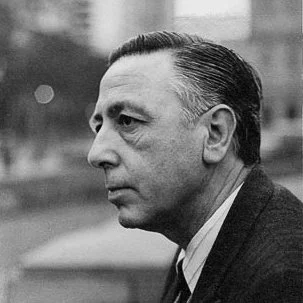
Roberto Pignataro, Argentine abstract artist and central figure in the exhibition project discussed in this article.
Marta Grimberg, director of the Museo Municipal de Artes Visuales during the brief 1976 museum merger.
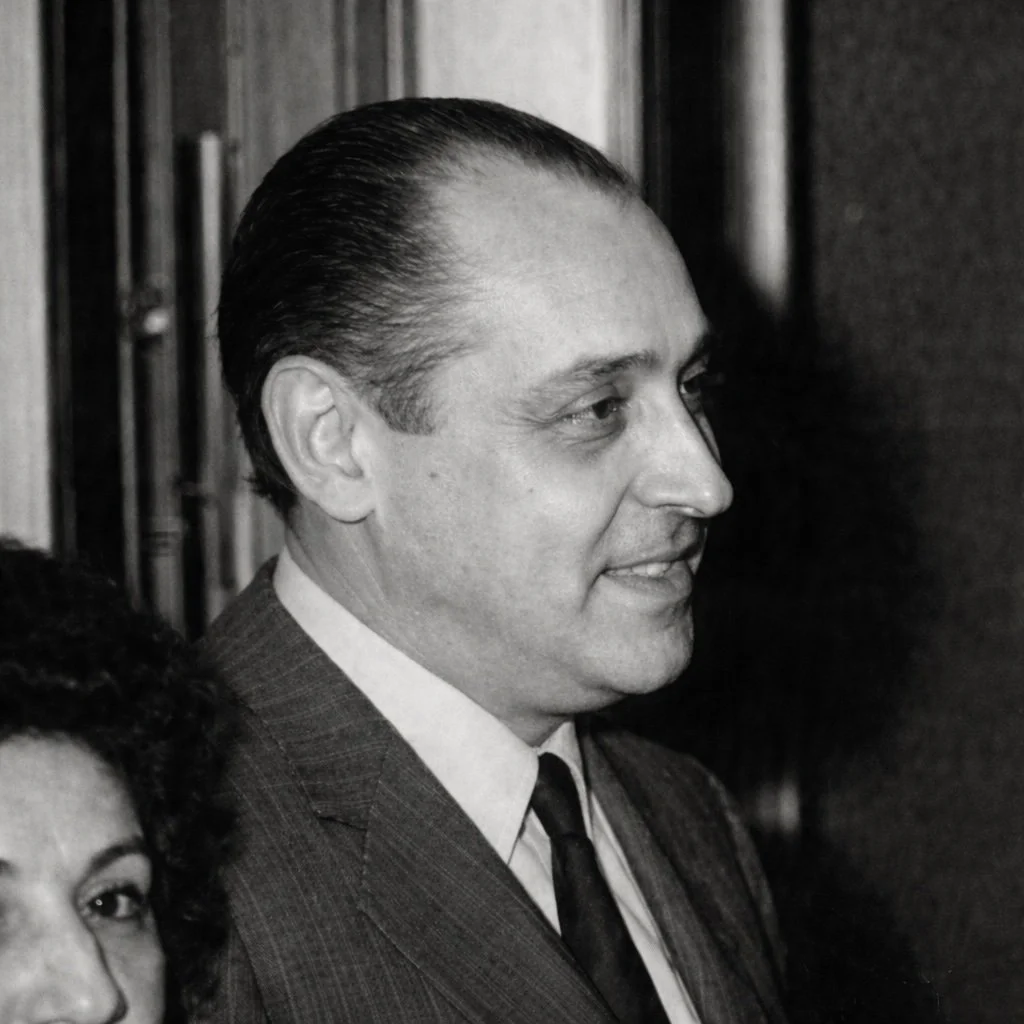
Guillermo Whitelow, art critic and director of the Museo de Arte Moderno de Bs As (1971-1974, 1977-1983)
Fortunately, their interactions with Pignataro can be traced through letters and personal memoranda preserved in his career archive. What follows reconstructs the story from these documents in chronological order, divided into sections for clarity and accompanied by occasional notes and reflections on the unfolding of events. Let’s dive in.
•••
Whitelow at Lirolay
▲ Personal memorandum documenting Guillermo Whitelow’s visit to Pignataro’s 1976 Galería Lirolay exhibition. July 26, 1976.
It was around mid-1976 when Pignataro began exploring the possibility of organizing a solo exhibition with the Museo Municipal de Artes Visuales. His initial contact with Marta Grimberg was arranged through someone identified in the surviving documents as “Mr. Barral,” leading to a meeting on October 12 of that year.
Although the precise circumstances surrounding that introduction remain unclear, a personal memorandum from the same period provides an intriguing piece of context. In it, Pignataro recounts a visit by Guillermo Whitelow to his July 12–24, 1976 exhibition at Galería Lirolay, roughly three months before his meeting with Grimberg.
Pignataro was not present when this visit took place, but gallery owner Mario Fano later told him that Whitelow had spent considerable time examining the works and spoke favorably of them, remarking that "had they come from abroad, they would have received the recognition they deserved." According to Fano, Whitelow also expressed a particular appreciation for the paintings that ventured furthest from figuration.
Considering Whitelow's long association with the Museo de Arte Moderno and the close succession of these events, it raises the question of whether he may have played a role in connecting Pignataro with Grimberg. Unfortunately, it is something the surviving documents leave unanswered, but it is nevertheless a strong possibility worth considering.
Setting the Stage
Early October, 1976
▲ Pignataro’s pre-meeting letter to the museum, October 1976.
In anticipation of his meeting with Grinberg, Pignataro mailed copies of his recent artistic books to the museum, requesting that they be incorporated into the institution’s library as a donation. The shipment included copies of R. Pignataro – A través de estampas, Volumen I (1968, author’s edition) and R. Pignataro – A través de estampas, Volumen II (1976, author’s edition).
In his accompanying letter, Pignataro requested that the volumes be considered for inclusion in the museum’s library collection and noted that they were provided free of charge as a donation.
Oct 12, 1976
Pignataro arrives at the museum with a carefully assembled dossier of materials documenting his recent work, including photographic reproductions of past exhibitions, printed material, and institutional references.
•••
The Meeting Takes Place
Before turning to the meeting itself, I wanted to include a few photographs of the interior of the Teatro General San Martín, where the museum was housed at the time. A major icon of Buenos Aires modern architecture in the 1960s, the building adds important visual context to the setting in which this episode began. The gallery below shows various sections of the building. Source: Estudio MRA+A.
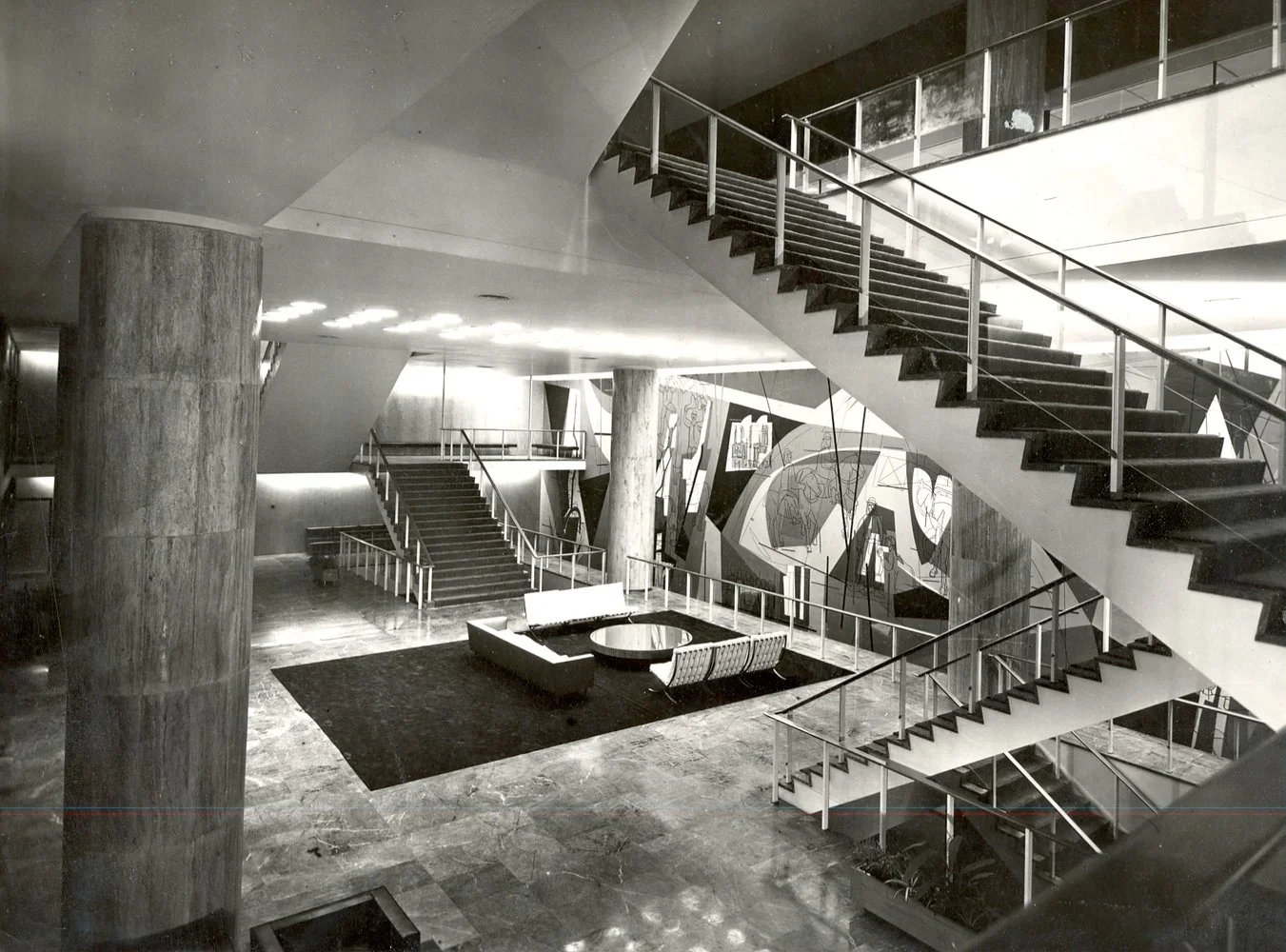
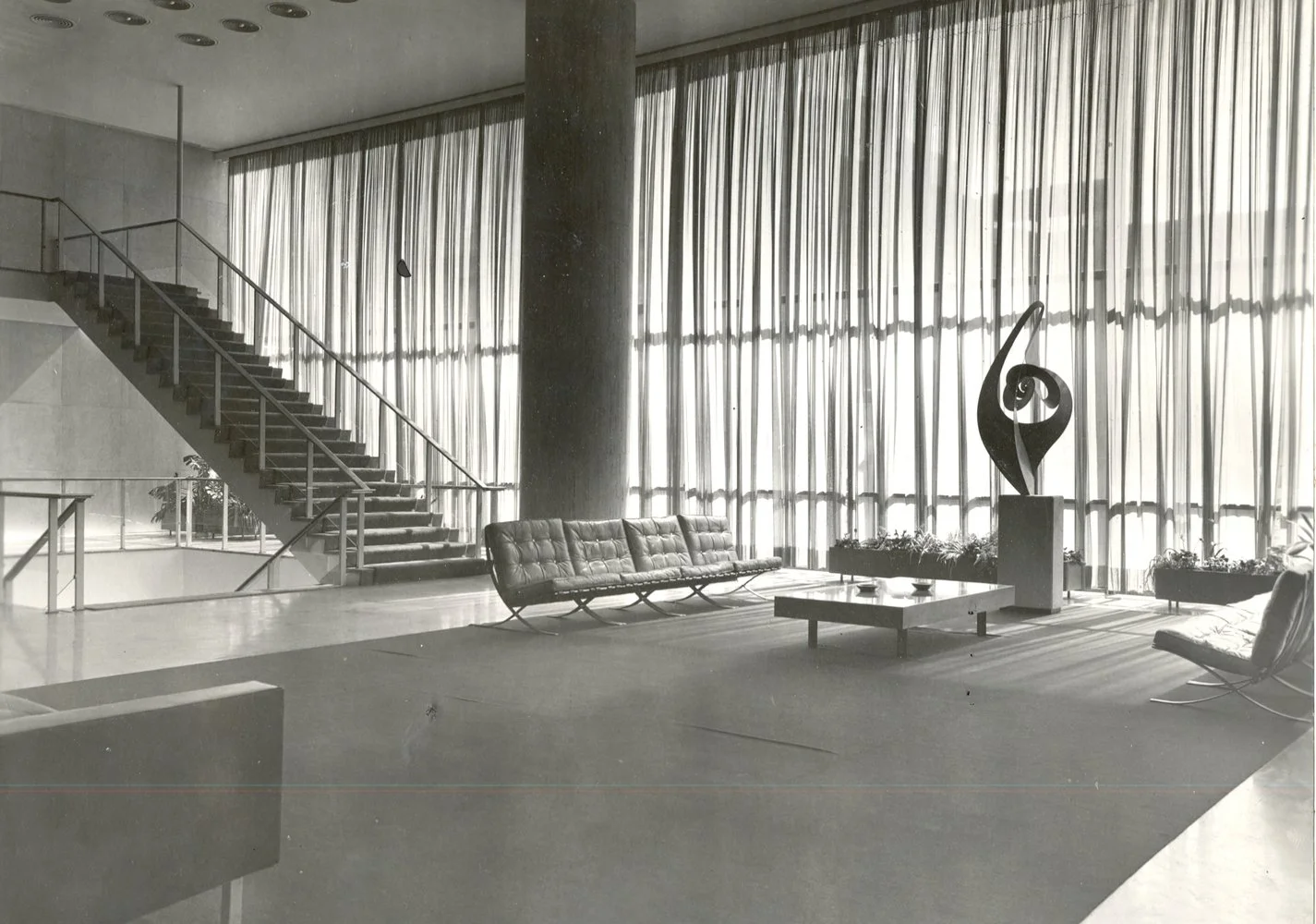
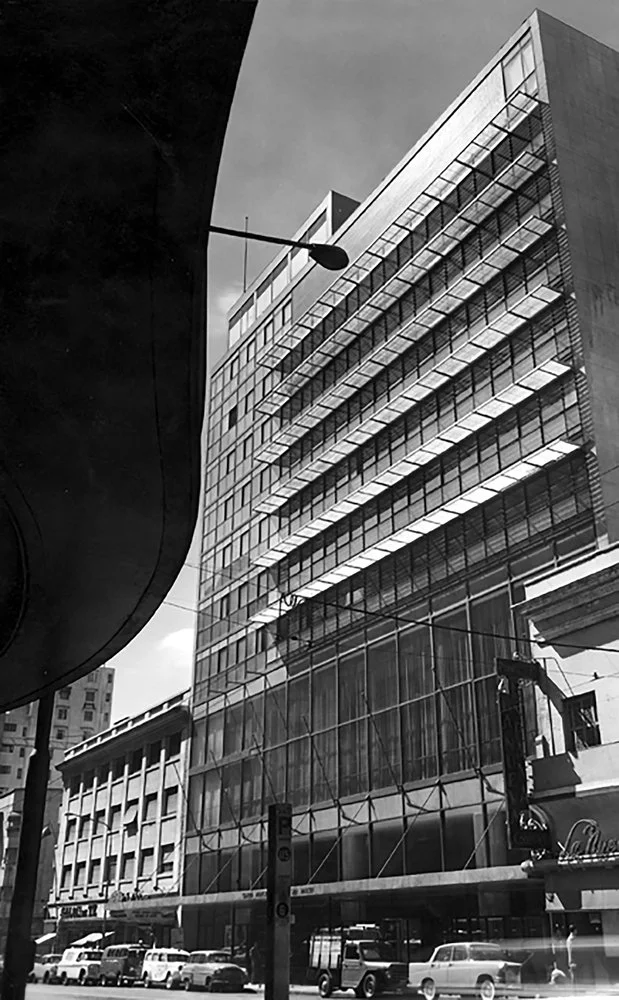
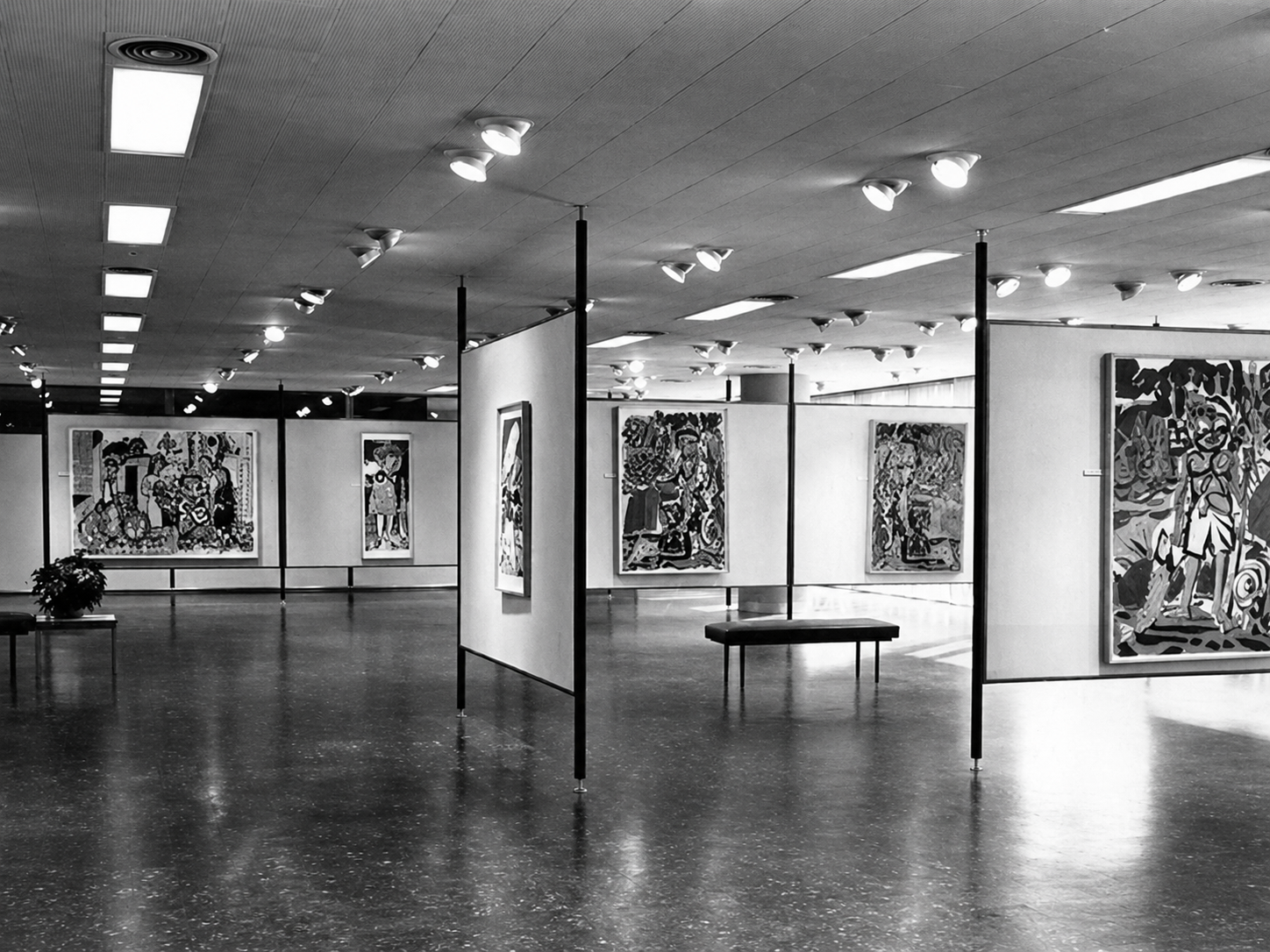
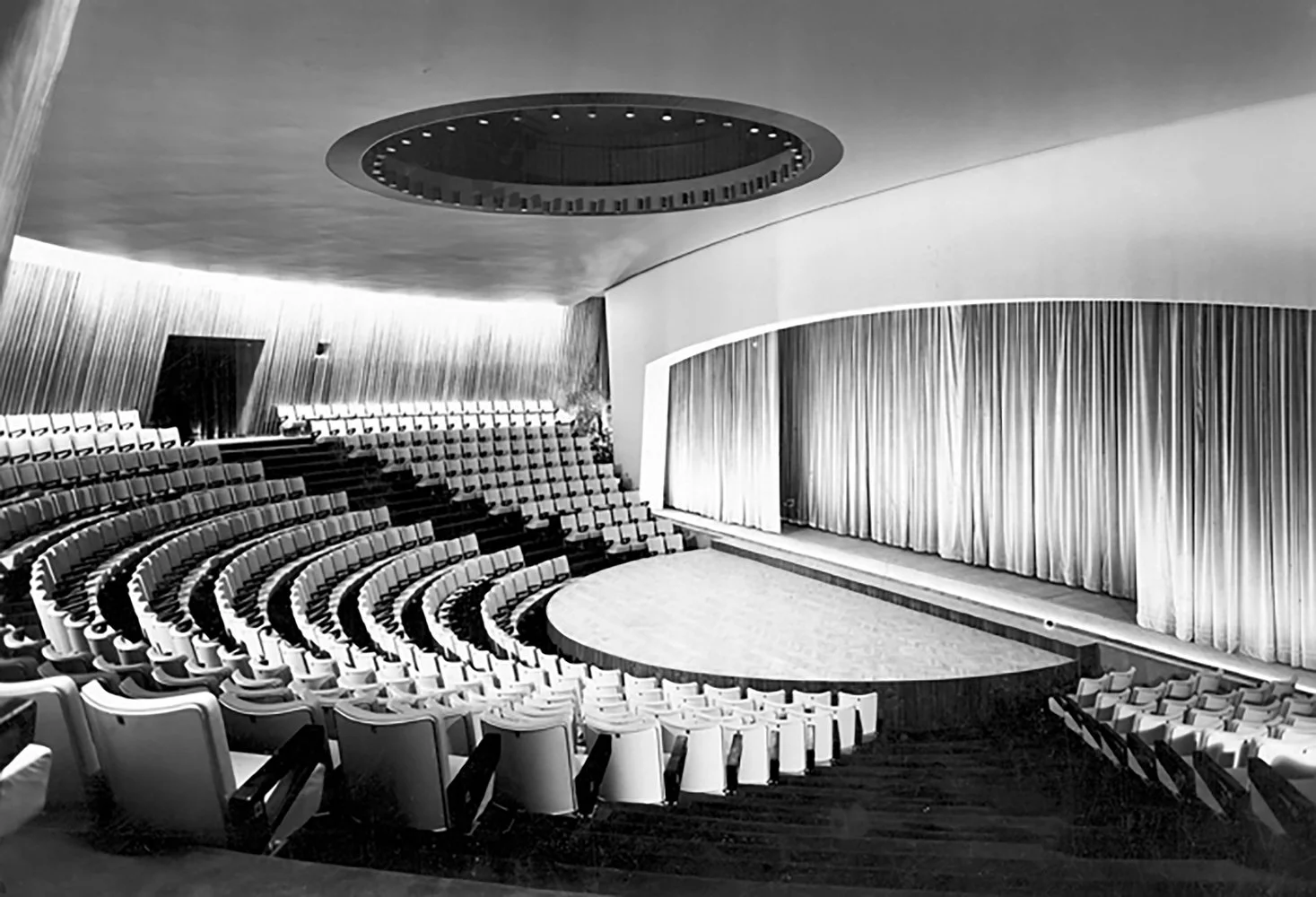
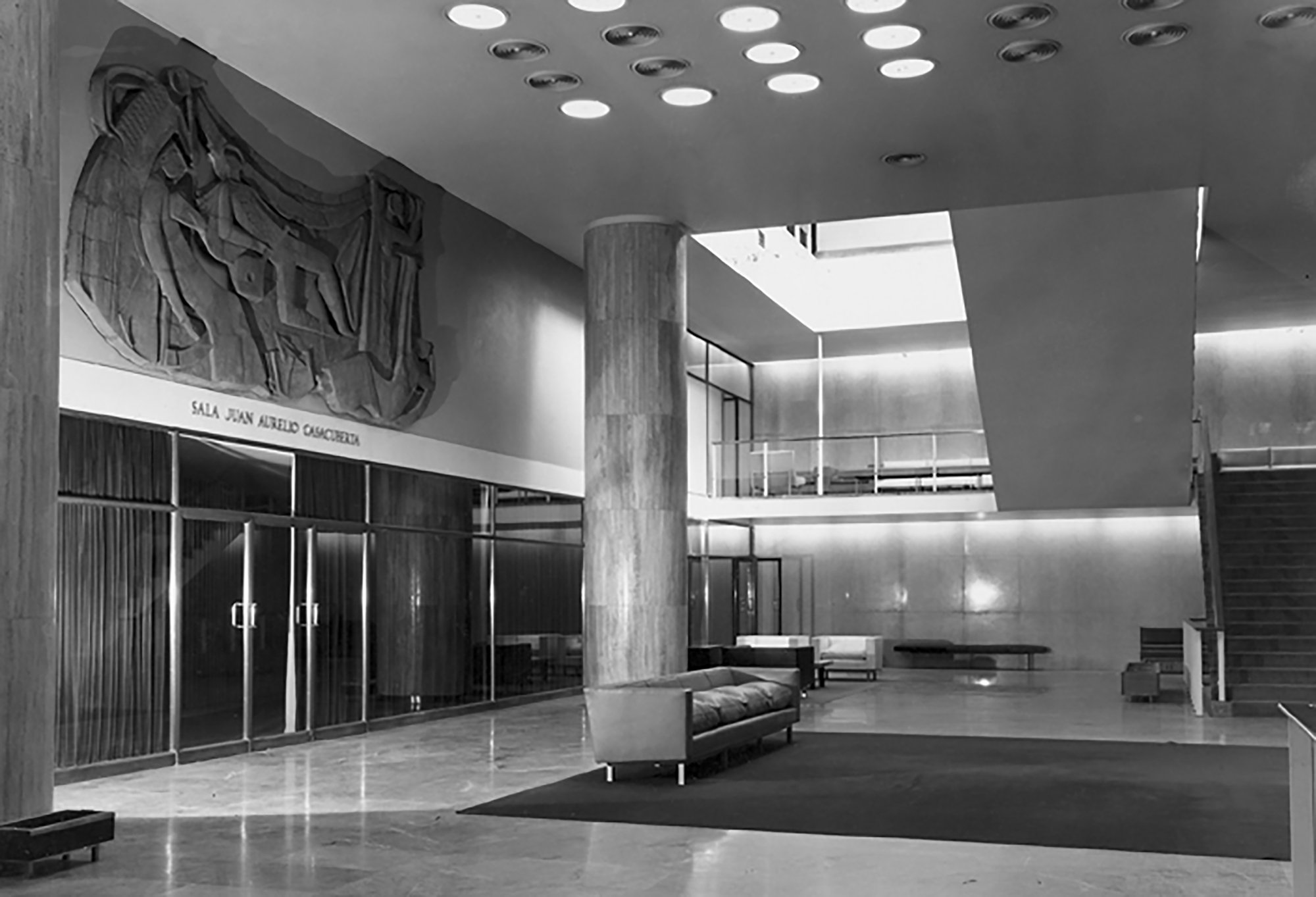
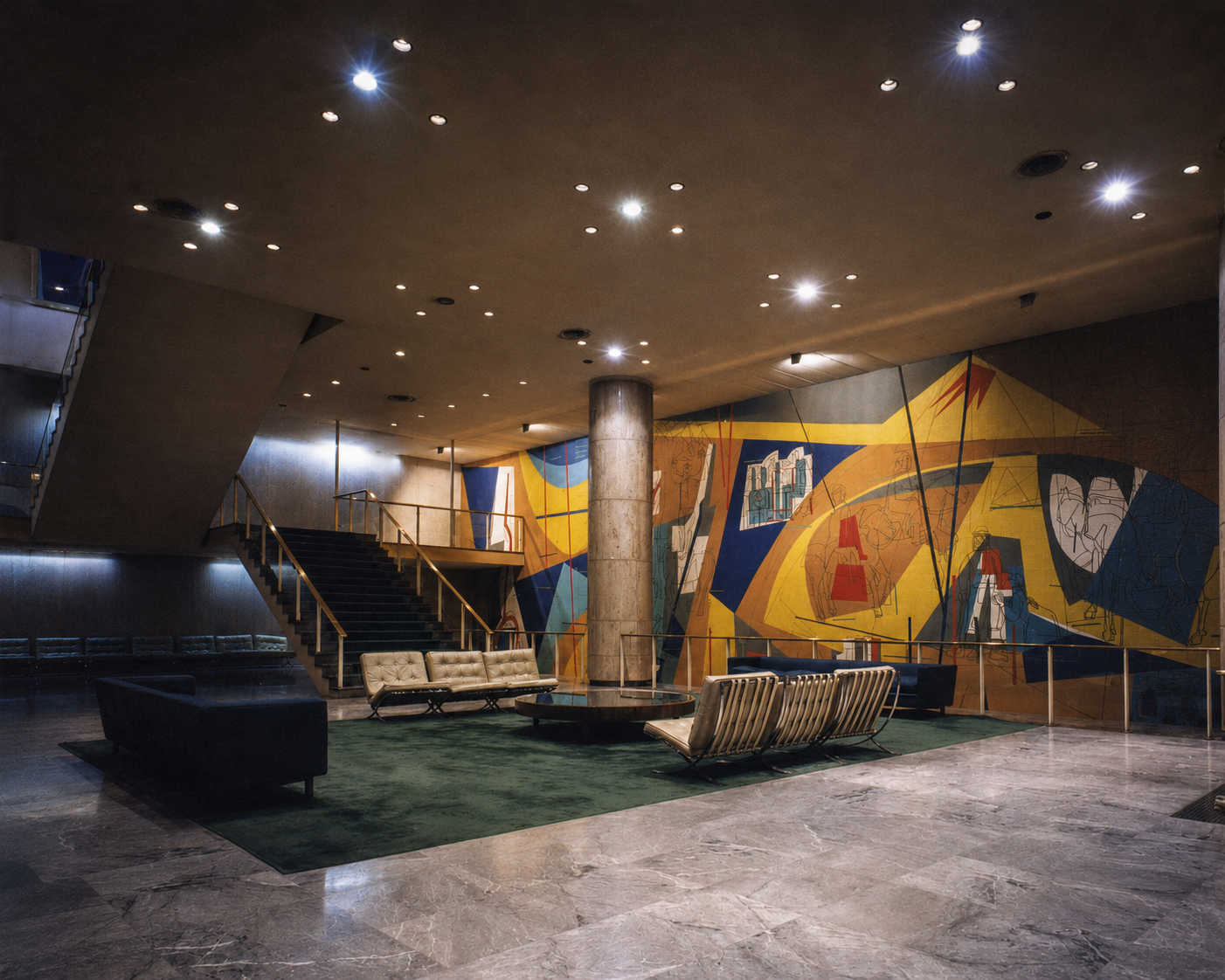
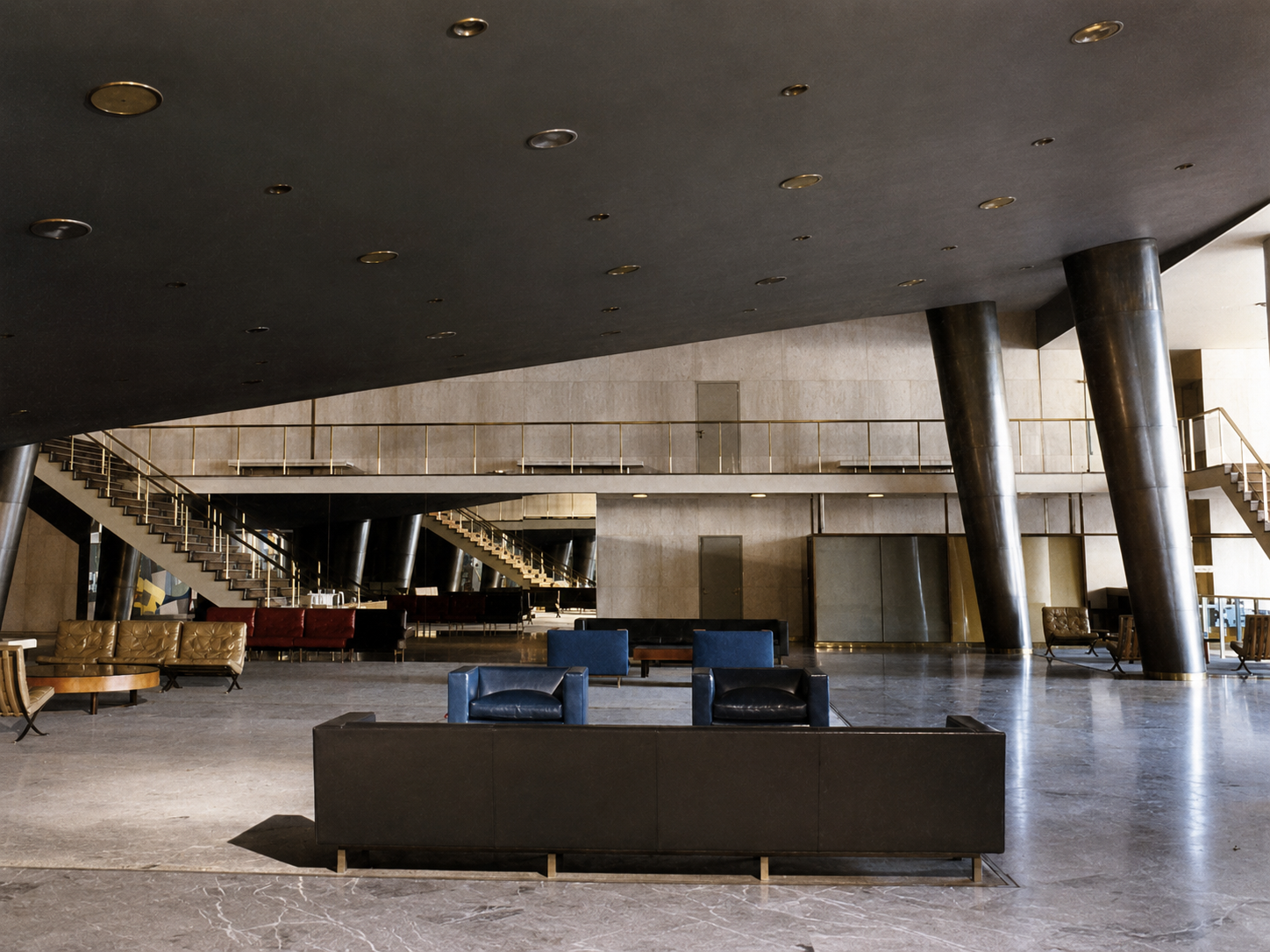
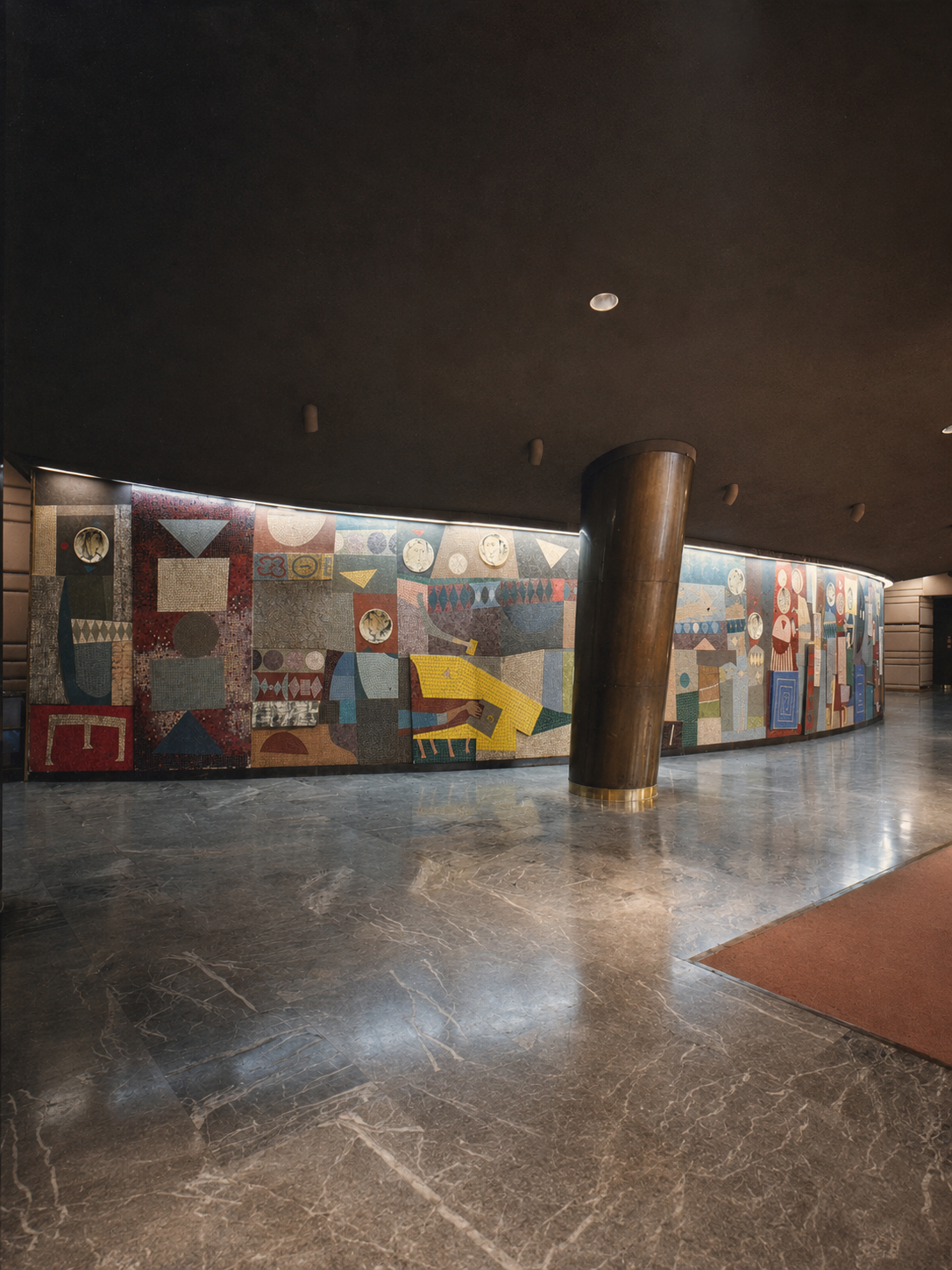
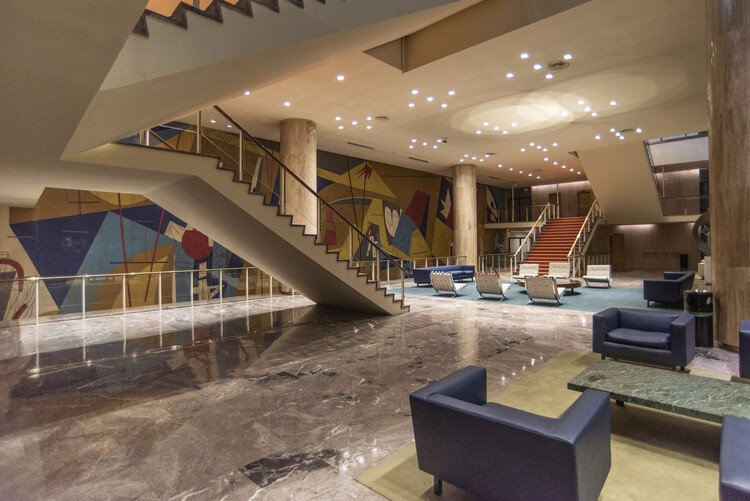
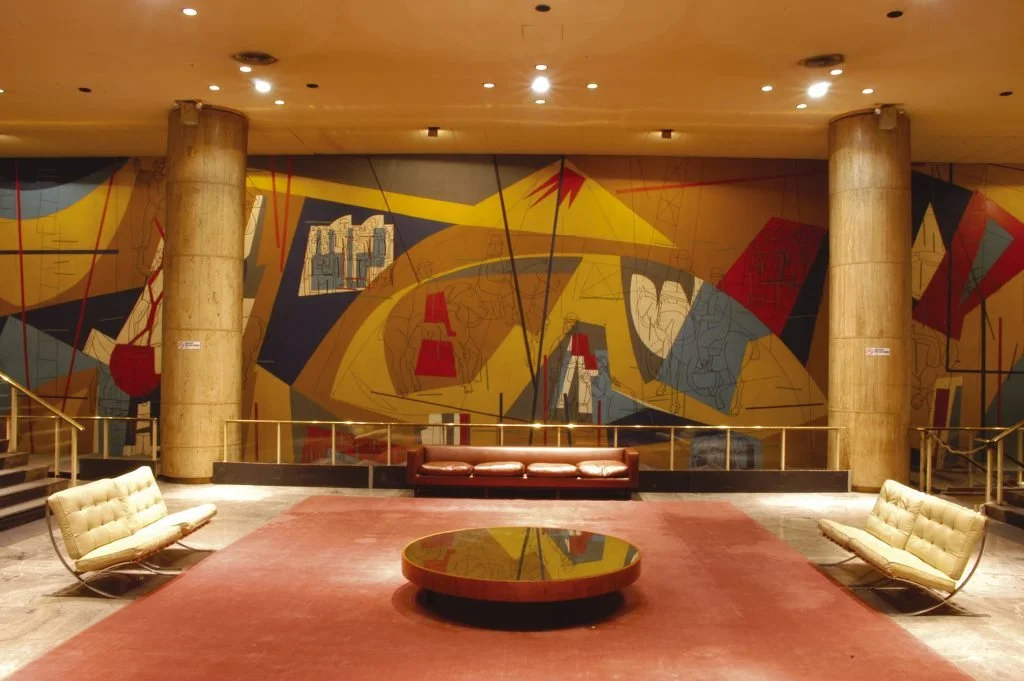
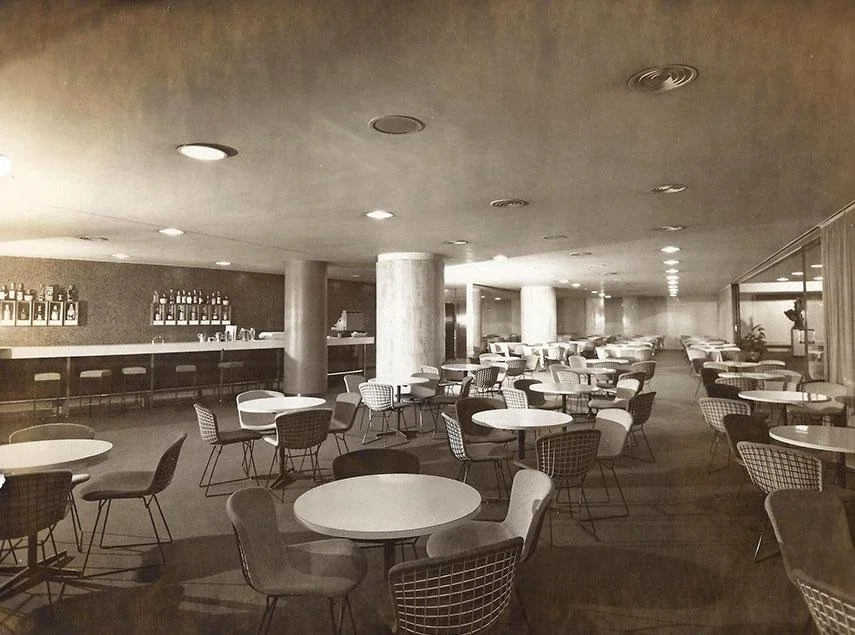
The exact location of the meeting is not recorded, but since the museum was housed on the 8th and 9th floors, it most likely took place there. With that in mind, let us begin the reconstruction:
After formal greetings, Grimberg begins by reviewing the museum’s existing dossier on Pignataro. She is struck by the volume of material and, after briefly examining A través de Estampas I, remarks that it belongs to “another era”—a reflection on the difficulties of producing such a publication under the spiraling economic conditions of the time. She shows particular interest in its contents, especially the illustrations.
Pignataro then presents additional material, including reproductions of exhibition brochures and photographs of his shows on “Florida y Lavalle” (a comercial galleria where Pignataro held a rotating artwork display). Grimberg studies the material attentively, pausing at several points and showing sustained interest.
Grimberg reviews supporting documents from various institutions, including the Museo de Arte Moderno de París, the Fondation Maeght, the Guggenheim, and Coltejer, as well as a text by Norman Geske related to the Venice Biennale.
She responds with particular enthusiasm to Pignataro’s En Slides Color project, noting its experimental nature and expressing interest in using it in an educational context. At one point, she remarks that she is excited about the work.
As the discussion turns to the possibility of an exhibition, Grimberg asks about the number and size of works from Pignataro’s 1970 exhibition at the Miami MoMA. She finds the idea of presenting those works again compelling, suggesting that such an exhibition could serve to “bridge” the two museums. This idea would later seem to crystallize in the projected exhibition title Dos Museos de Arte Moderno.
The conversation then turns to the exhibition itself. Pignataro proposes approximately twenty-five collages. Grimberg notes that the gallery can accommodate more, around forty pieces, and briefly suggests supplementing the exhibition with a compatible sculptor. Pignataro offers to produce more instead, but she proposes larger ones. They agree on this point.
Pignataro then suggests producing new works as a development of the Miami series, expanding on its technique of torn-and-paste paper elements. Grimberg agrees with this direction.
Grimberg reviews the museum’s program for 1976, noting that it is already complete. A recent postponement—when Carmelo Carrà asked to move his exhibition—had briefly opened a slot, but it was already taken by another artist. She suggests instead a later date, tentatively placing the exhibition in April 1977.
In the course of the conversation, she makes a candid remark: the merger between the Museo de Arte Moderno and the Sívori is not widely supported and unlikely to last. This will later prove consequential.
In the final moments of the meeting, Grimberg indicates that, once the program is finalized, Pignataro will be contacted to formalize the arrangement through a contract. Pignataro leaves her a copy of his book A través de Estampas II, and the meeting concludes shortly thereafter.
Oct 13, 1976
The day after the meeting, in a telephone conversation with Barral, Pignataro learns that Grimberg had spoken favorably of his work to Mr. Camarotta, who was responsible for the museum’s internal documentation.
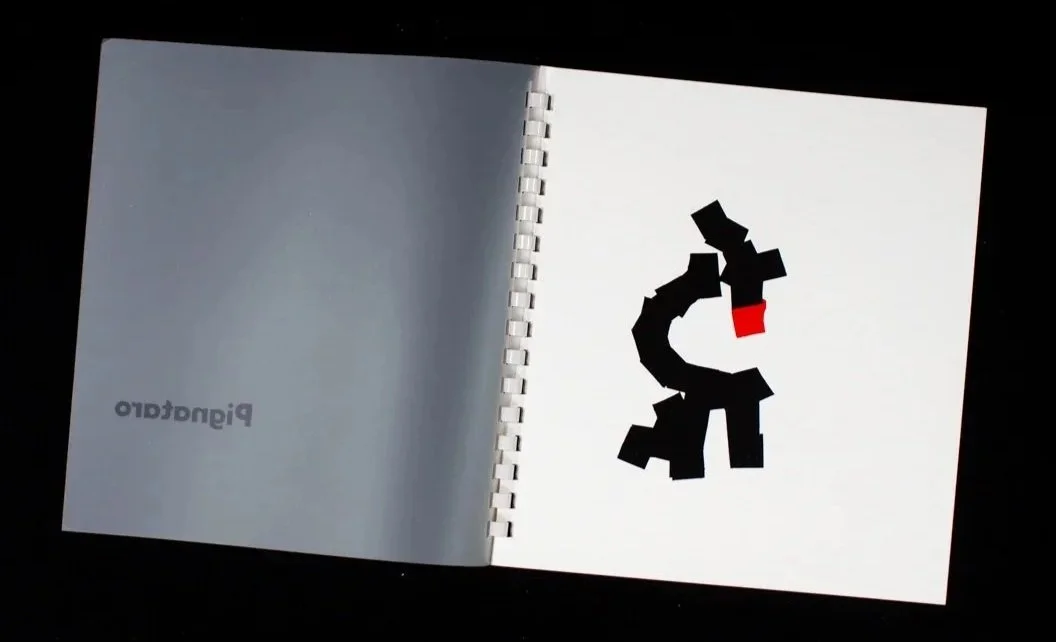
▲ A través de Estampas II, the nine-page artist’s booklet Pignataro gave to Grimberg at the end of their meeting. Its minimal abstract visual language would later inform the aesthetic direction of the planned exhibition.
•••
Exhibition Not Found
Fast forward to March 1977. A curious five-month gap separates the October 12 meeting from the next documented communication between Pignataro and the museum. Yet the silence is not entirely surprising: the exhibition had been discussed, a date and title assigned, and the project appeared to be moving forward. In the absence of any indication to the contrary, Pignataro simply continued working under that expectation.
By the time contact resumes on March 30, 1977, however, the ground had shifted. The merger had completely unraveled and the Museo de Arte Moderno was no longer operating under the same leadership. As for the exhibition itself… it was suddenly nowhere to be found, vanished from the museum’s programming, with no explanation given. Pignataro begins to seek answers.
Mar 30, 1977
Confronted with the apparent disappearance of the exhibition, Pignataro writes to the museum to express his concern over what he describes as an “undeserved situation.”
Pignataro states that the exhibition, titled Dos Museos de Arte Moderno, had been assigned a definitive date in the second half of April. Yet with that date fast approaching, there was still no indication that the show would take place.
As a side note, it had been only six years since the Miami MoMA fiasco—the international exhibition discussed earlier, which nearly collapsed after a gross act of negligence by the artwork shippers. One can only imagine Pignataro’s disbelief of finding himself, once again, staring at comparable levels of institutional absurdity.
•••
The Museum Responds
The museum begins to respond to the situation—but only by altering the terms of what had originally been agreed, placing Pignataro in a difficult position.
Apr 15, 1977
A reply arrives from the Subsecretariat of Culture—but it brings no answers. Pignataro is informed that his letter has been forwarded to the museum for review and that a report has been requested. The status of the exhibition itself is left unaddressed.
It is unclear what may have taken place between April 15 and and the next documented interaction of June 3, but with no resolution forthcoming, Pignataro appears to have lost faith that the situation would be resolved within a reasonable timeframe and on acceptable terms.
Since maintaining at least one exhibition per year was essential to remain visible within the art scene, he begins putting a fallback plan in motion. He returns to a familiar venue—Galería Lirolay—where he schedules a new exhibition for June 13 and channels into it artistic ideas originally conceived for the Museo de Artes Visuales.
Even so, he does not let the matter go.
Jun 3, 1977
Pignataro calls the museum, but the call goes unanswered.
Jun 6, 1977
He sends a certified reiteration of his earlier letter, again seeking answers.
Jun 7, 1977
Mr. Del Villano at the museum telephones Pignataro to propose an alternative plan: a group exhibition in August, shared with other artists. Pignataro hesitates. The offer does not correspond to the original agreement, and he indicates that he will need time to respond.
Jun 9, 1977
Pignataro declines the proposed group exhibition, citing timing, stress, and costs.
The matter, however, does not end there. It remains under consideration by both the Subsecretariat and the museum’s leadership, while Pignataro proceeds with the fallback exhibition he has already set in motion.
To better understand Pignataro’s refusal, the timing is essential. The museum had taken more than two months to respond meaningfully to a bad situation it had created. In the meantime, facing uncertainty and unwilling to lose his window of visibility, Pignataro had already redirected the work toward Lirolay. By the time the museum returned with an August proposal, the terms had changed, the trust had been damaged, and the time available to produce a new body of work had become unreasonably short. What may have appeared to the museum as a practical compromise could only have felt to Pignataro like a diminished offer arriving after the damage had already been done.
•••
The Lirolay Exhibition
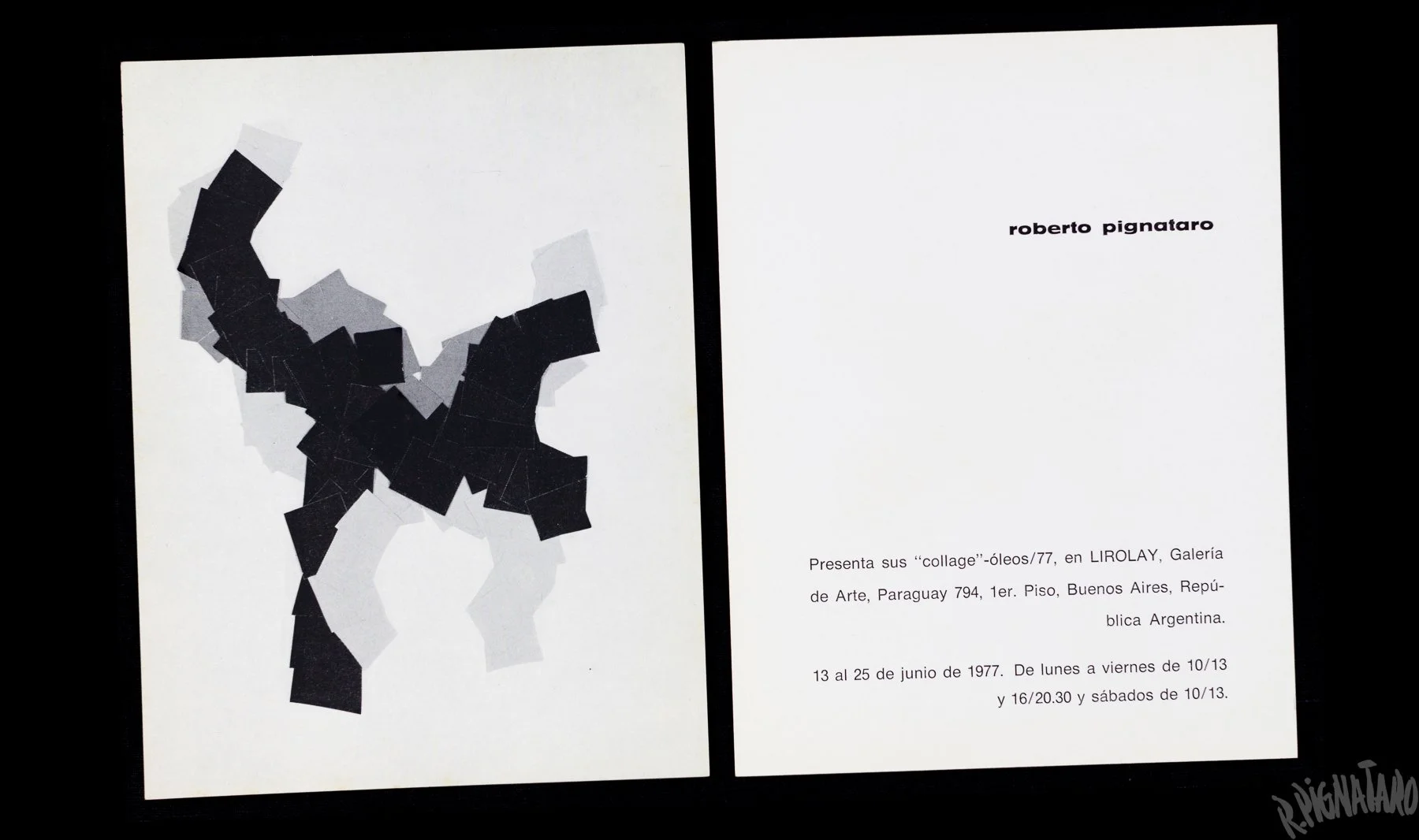
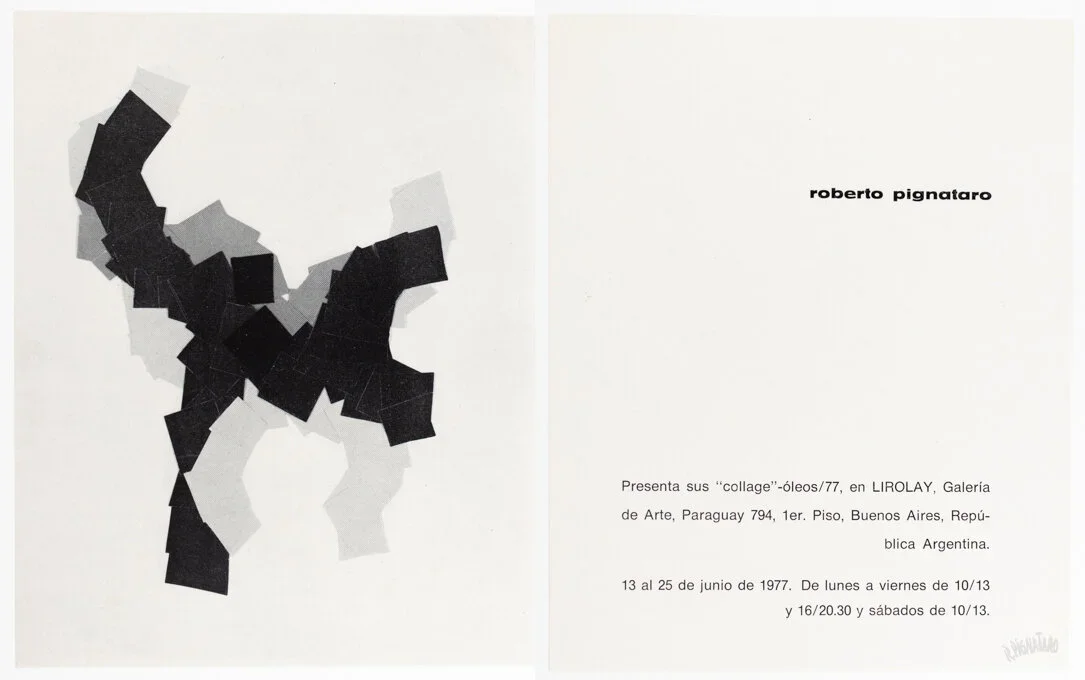
▲ Invitation card for Pignataro’s 1977 exhibition at Galería Lirolay, designed by the artist.
Amid all the disarray, Pignataro inaugurates his solo exhibition at Galería Lirolay. The exhibition remains on view from June 13 through June 25, 1977. During its run, a notable visit offers a measure of reassurance.
Jun 13, 1977
The exhibition opens.
Jun 17, 1977
Bernardo Graiver, a writer and cultural figure with ties to the Buenos Aires art scene, visits Pignataro’s exhibition at Lirolay. He immediately recognizes the work on view as consistent with earlier exhibitions and materials he had seen over time.
During the visit, Graiver learns that the works had originally been intended for a suspended exhibition at the Museo de Artes Visuales, and that Del Villano had recently called to revive the project. He reportedly regards that call as both important and validating for Pignataro.
Graiver goes on to identify several works in the exhibition as fully worthy of appearing in a museum, singling out specific pieces and expressing broader interest in the show. He also mentions that a potential buyer had inquired about the work, a further sign that it was attracting attention beyond the stalled museum project.
•••
About the Artwork
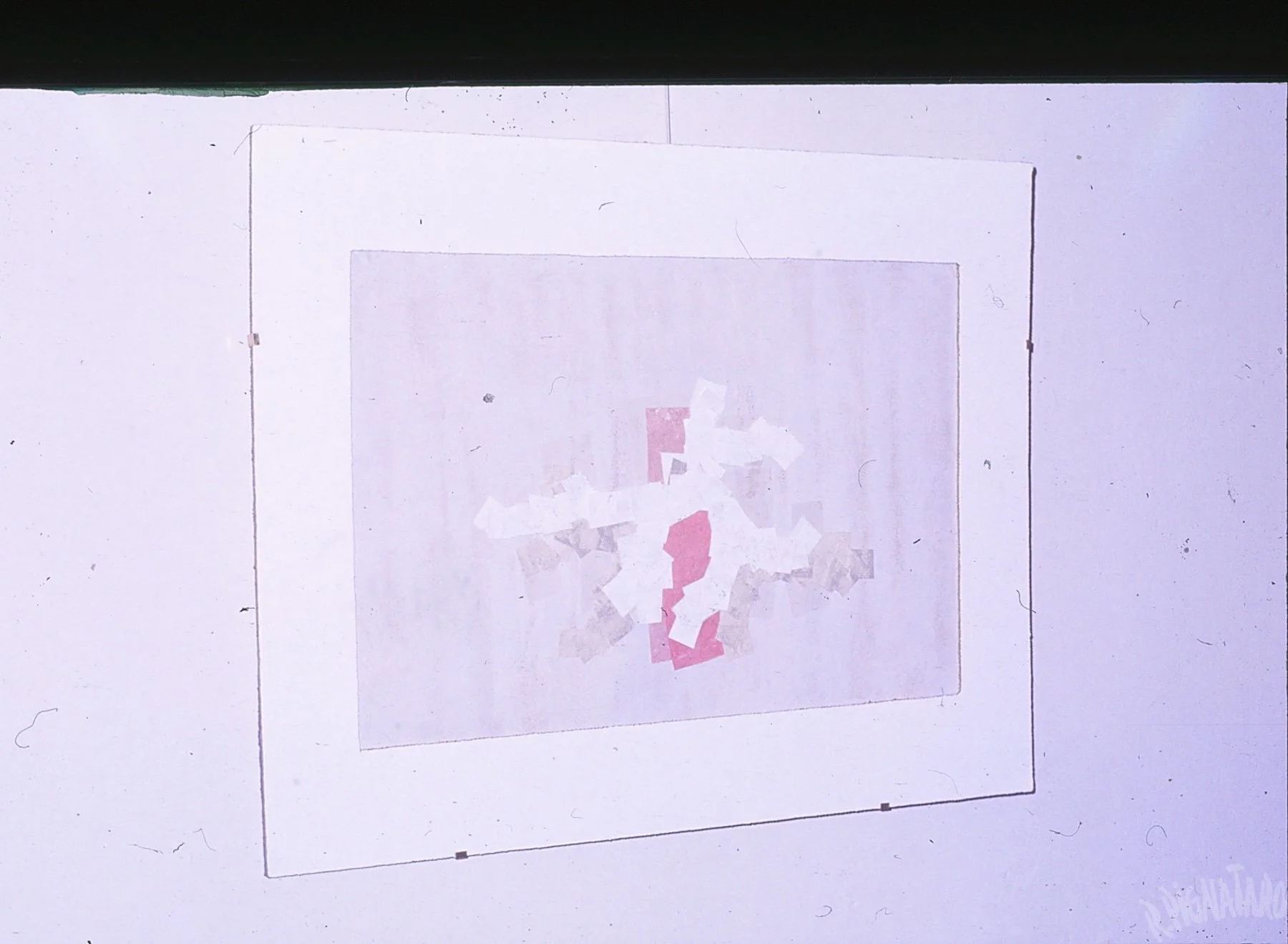
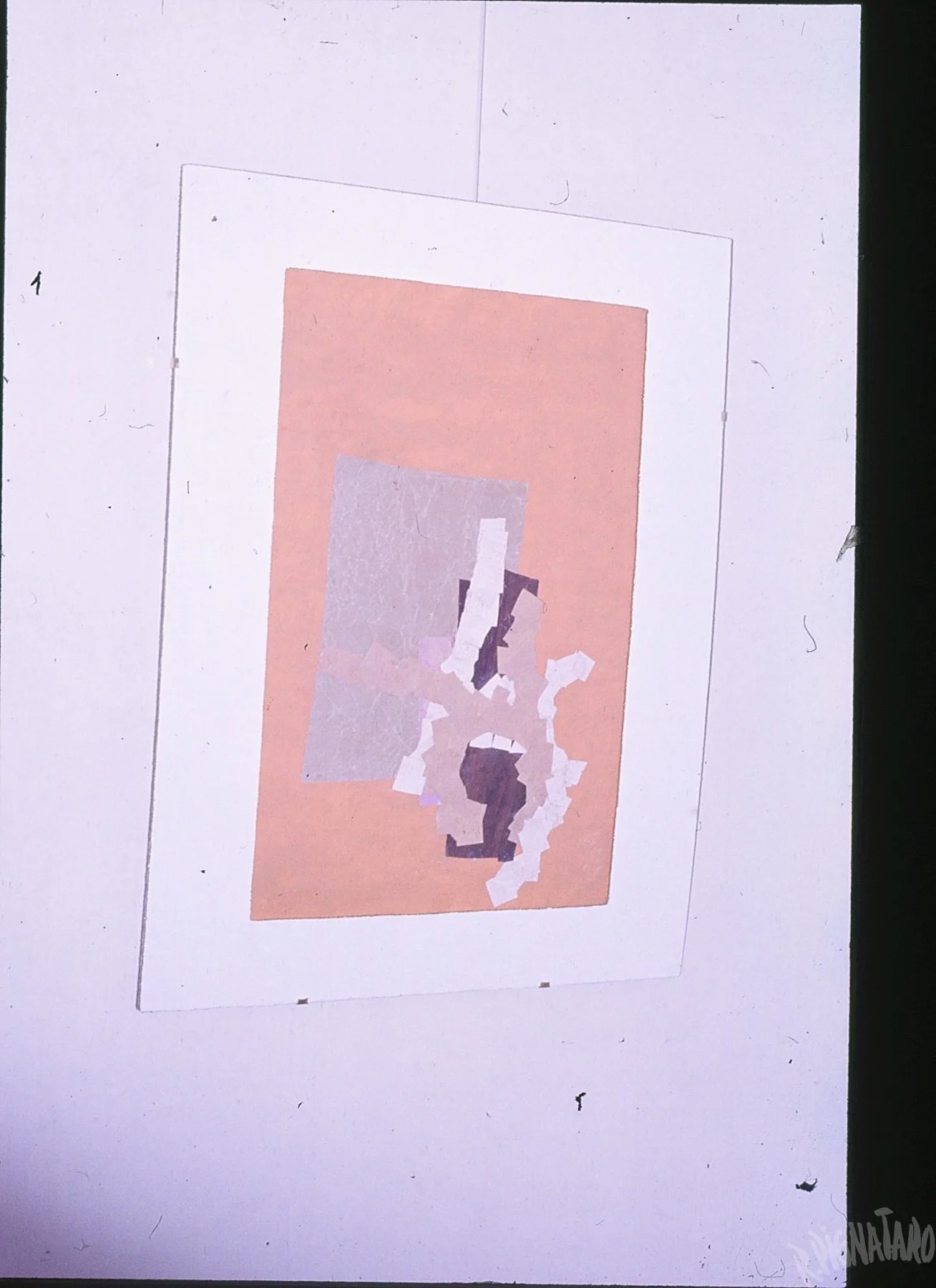
Before proceeding further with the story, I wanted to take a moment to consider the artistic direction Pignataro was exploring at the time. The photo gallery below presents color slides of the Lirolay exhibition, taken by Pignataro, and offers a sense of the work he had envisioned for the museum.
Built from scissor-cut paper fragments, these works form part of what might be called “abstract storytelling.” Their shapes suggest small dramas in motion—forms that hover, cluster, collide, or drift without ever settling into a literal image. Shown as a series, their cohesive aesthetic suggests a visual narrative, inviting the viewer into a game of creative interpretation.
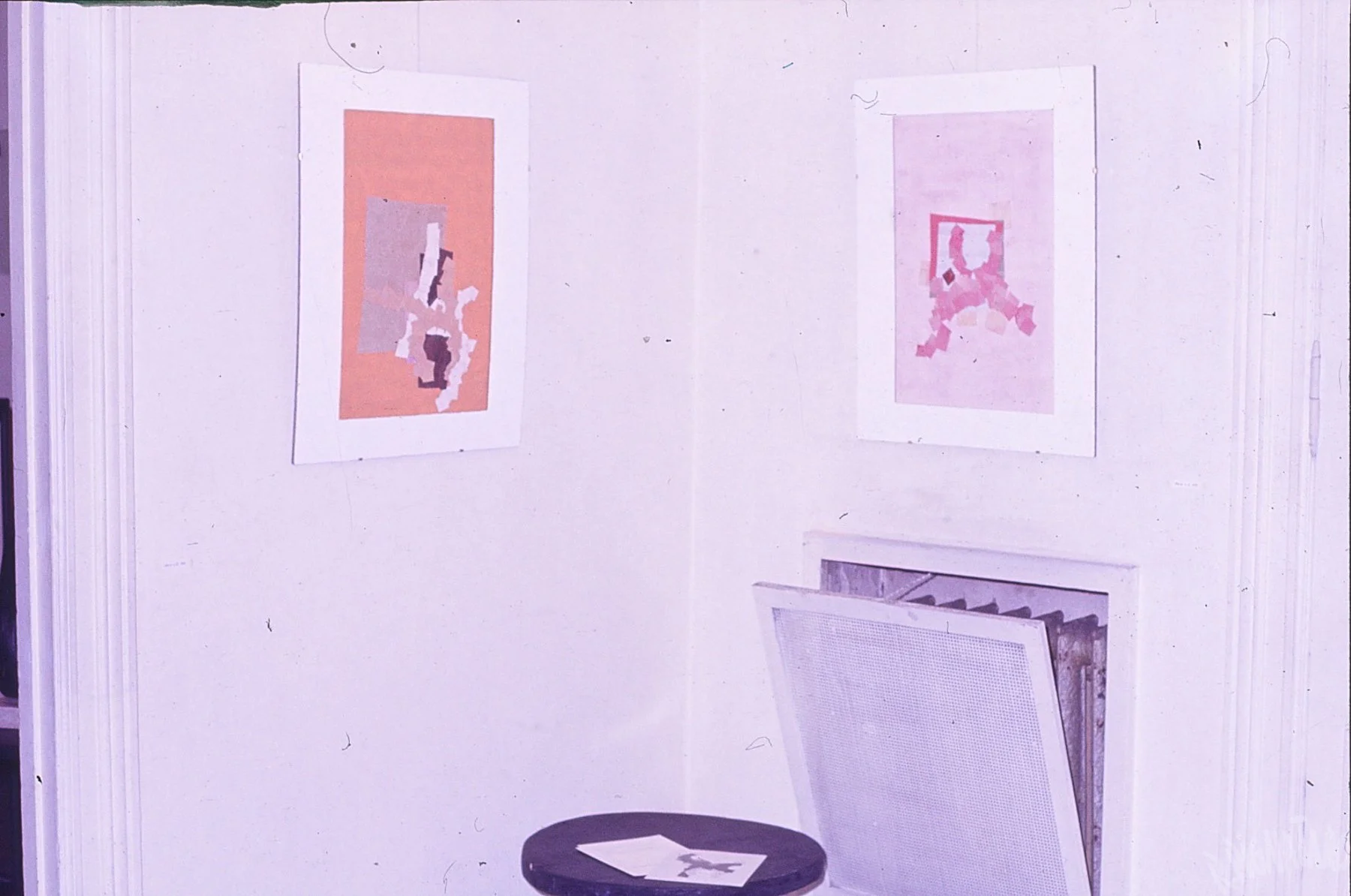
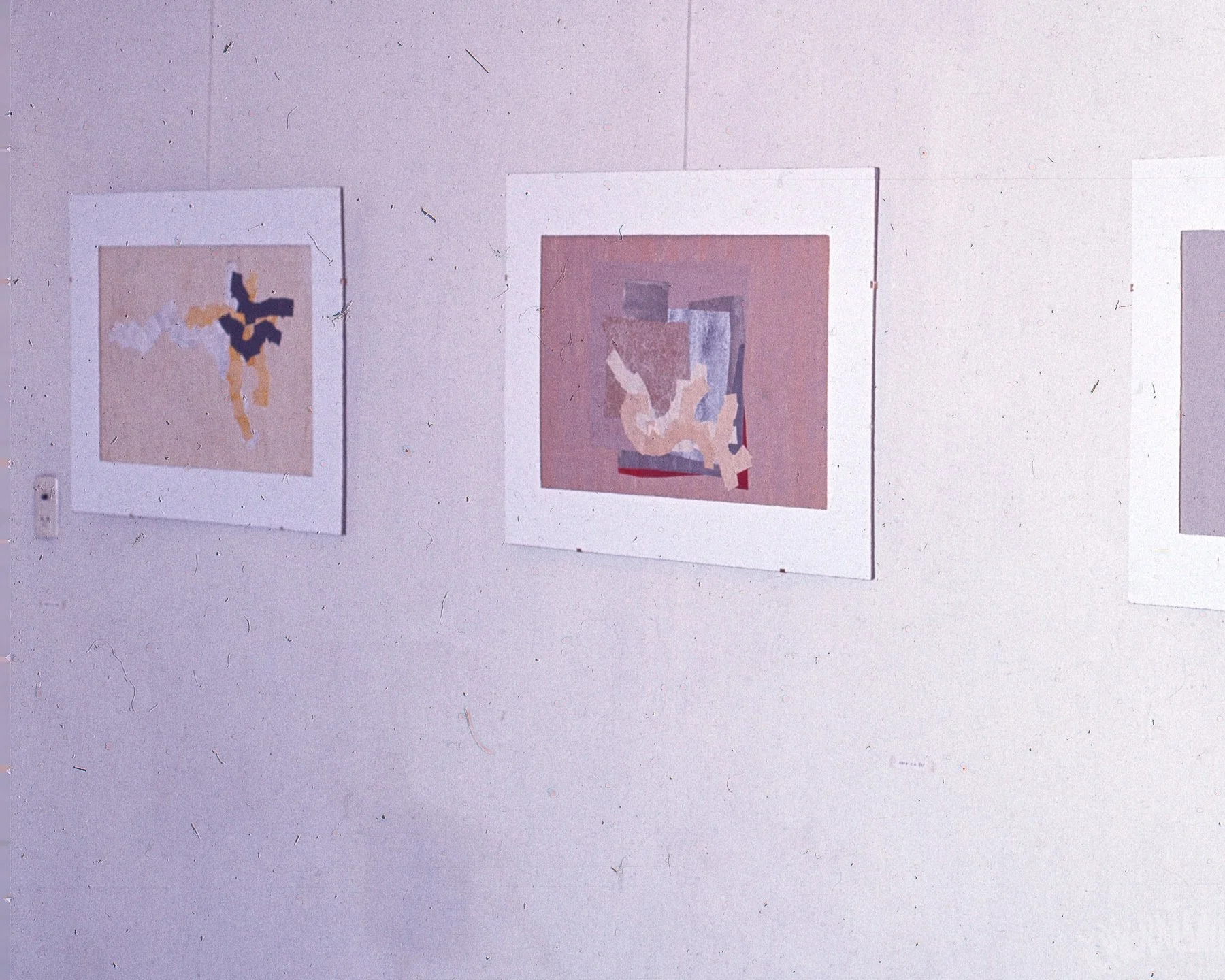
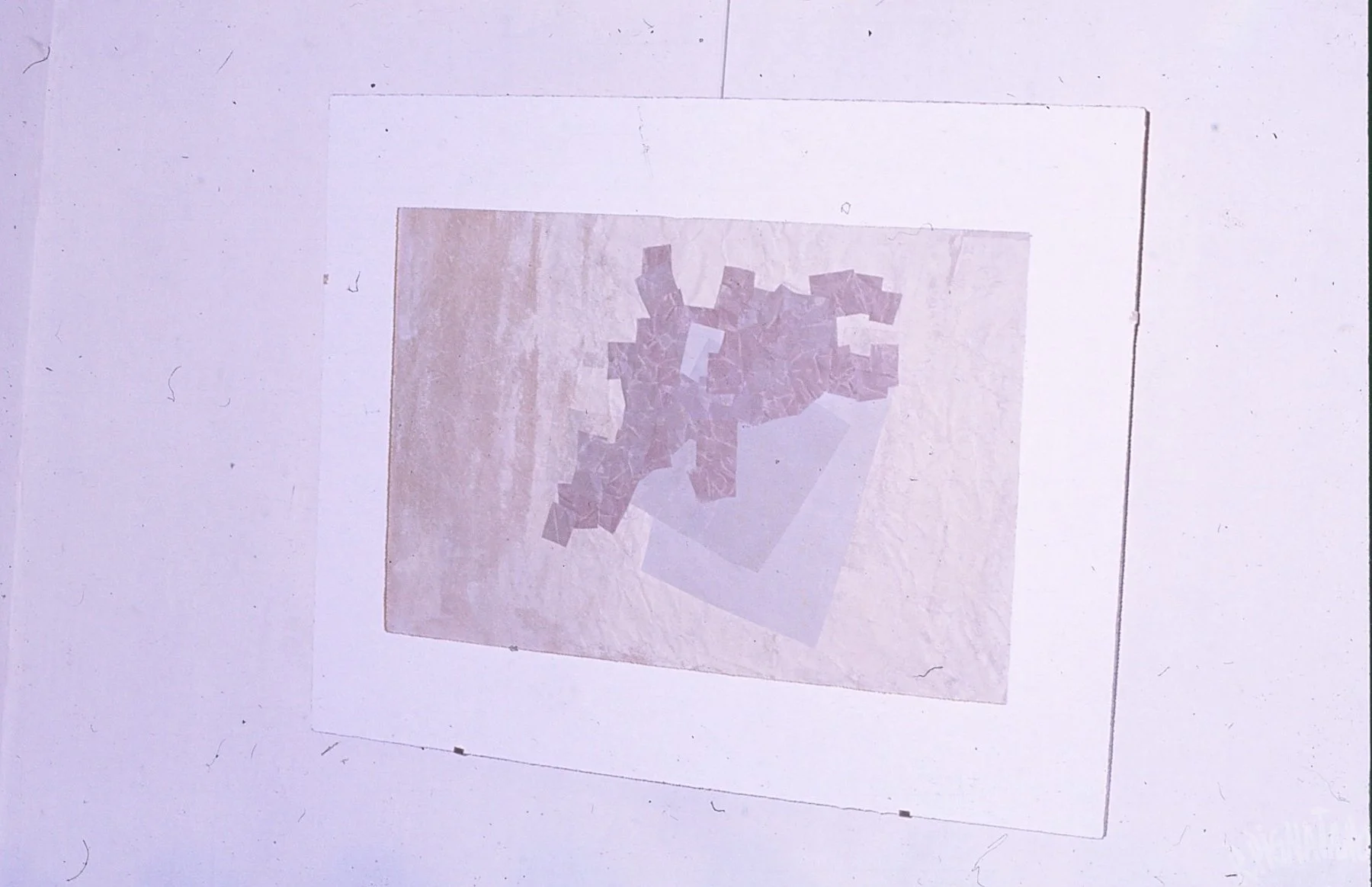
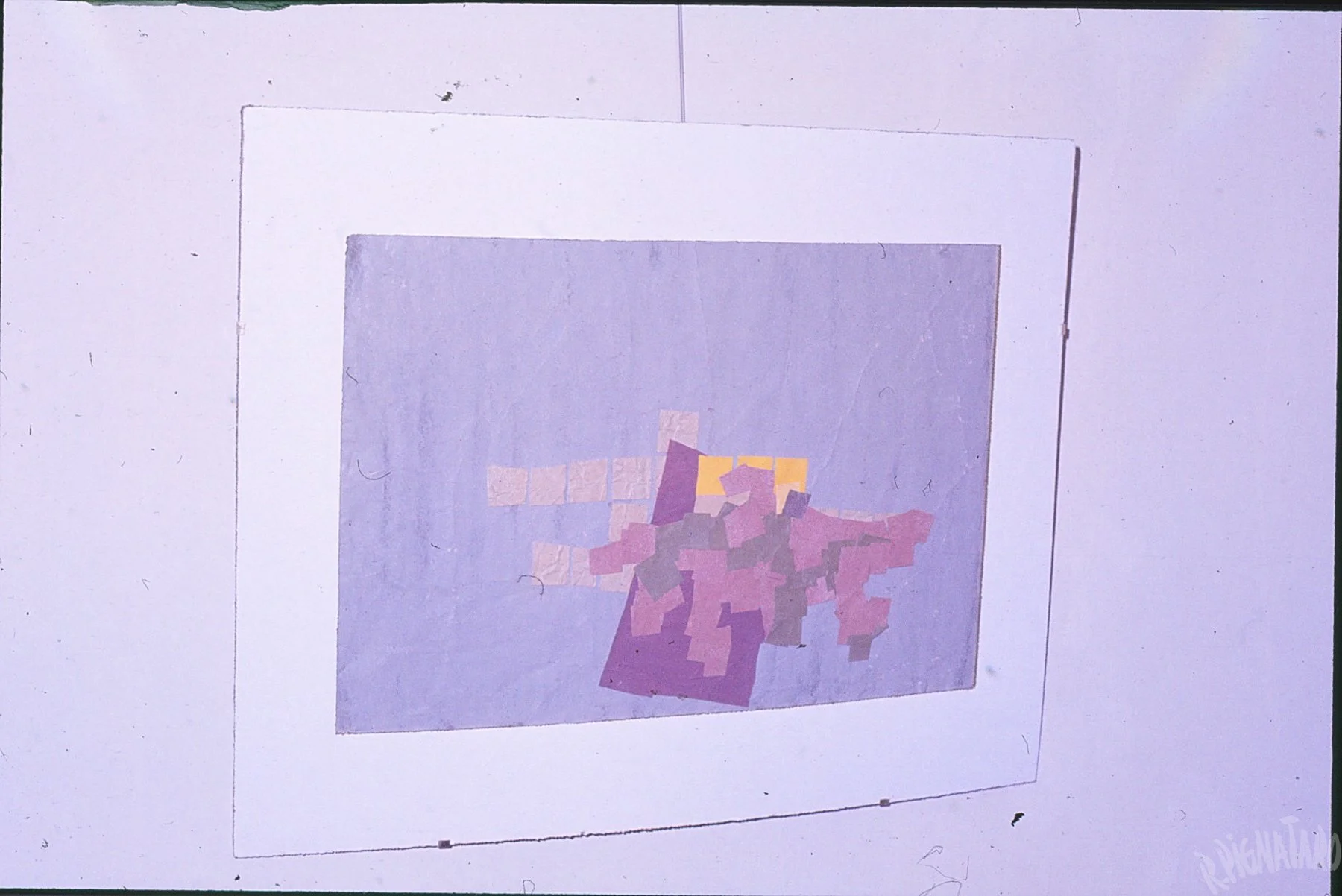
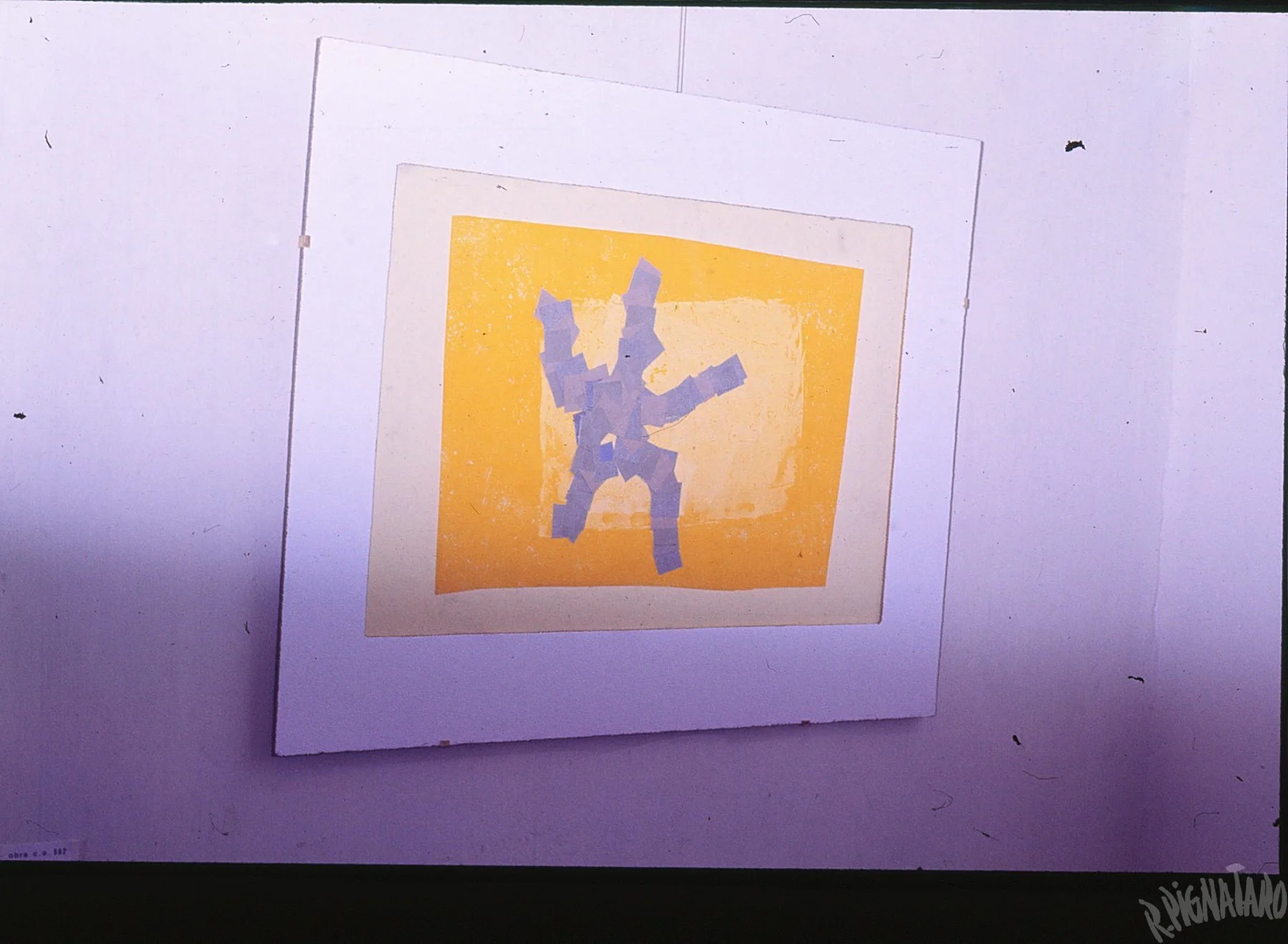
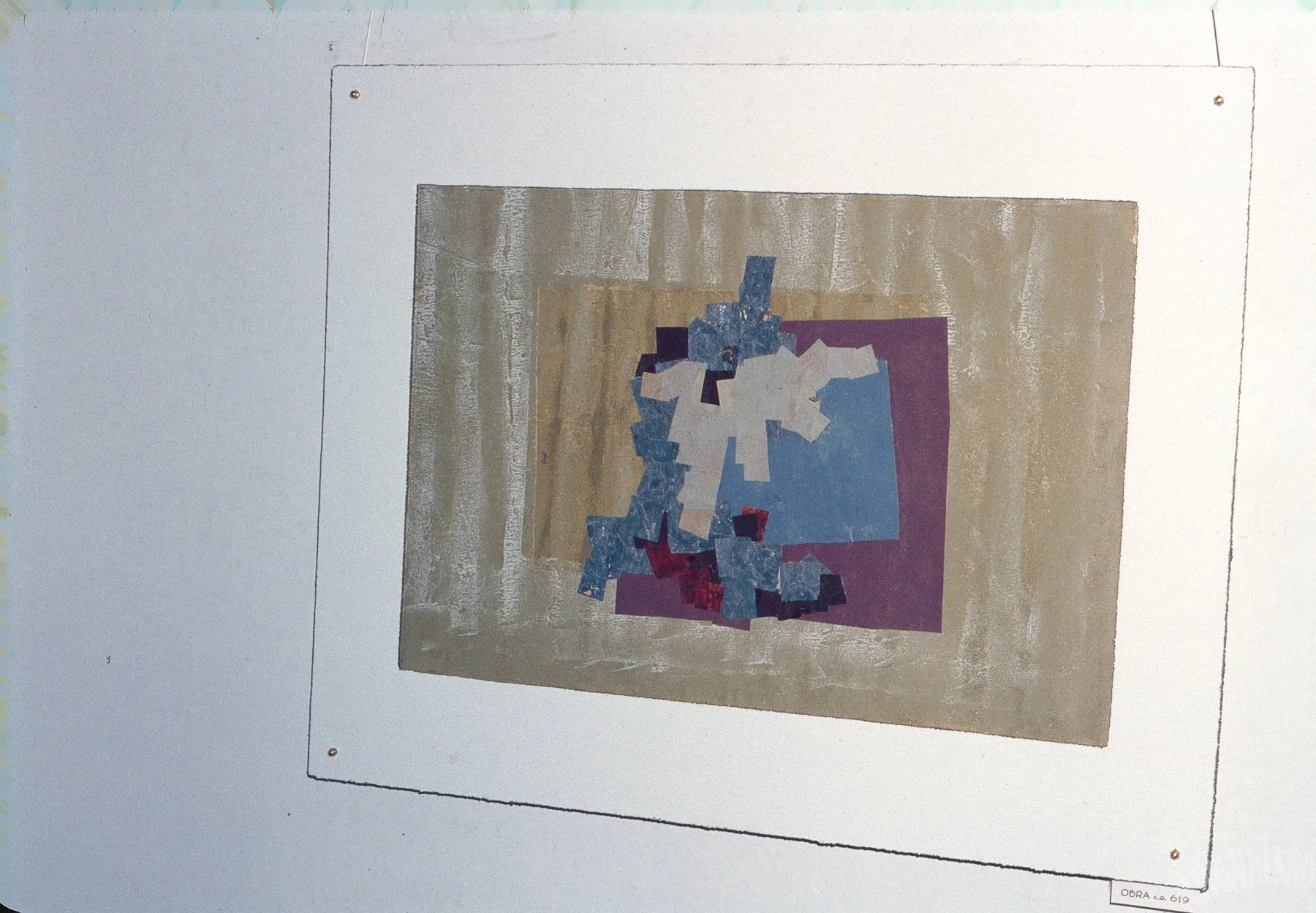
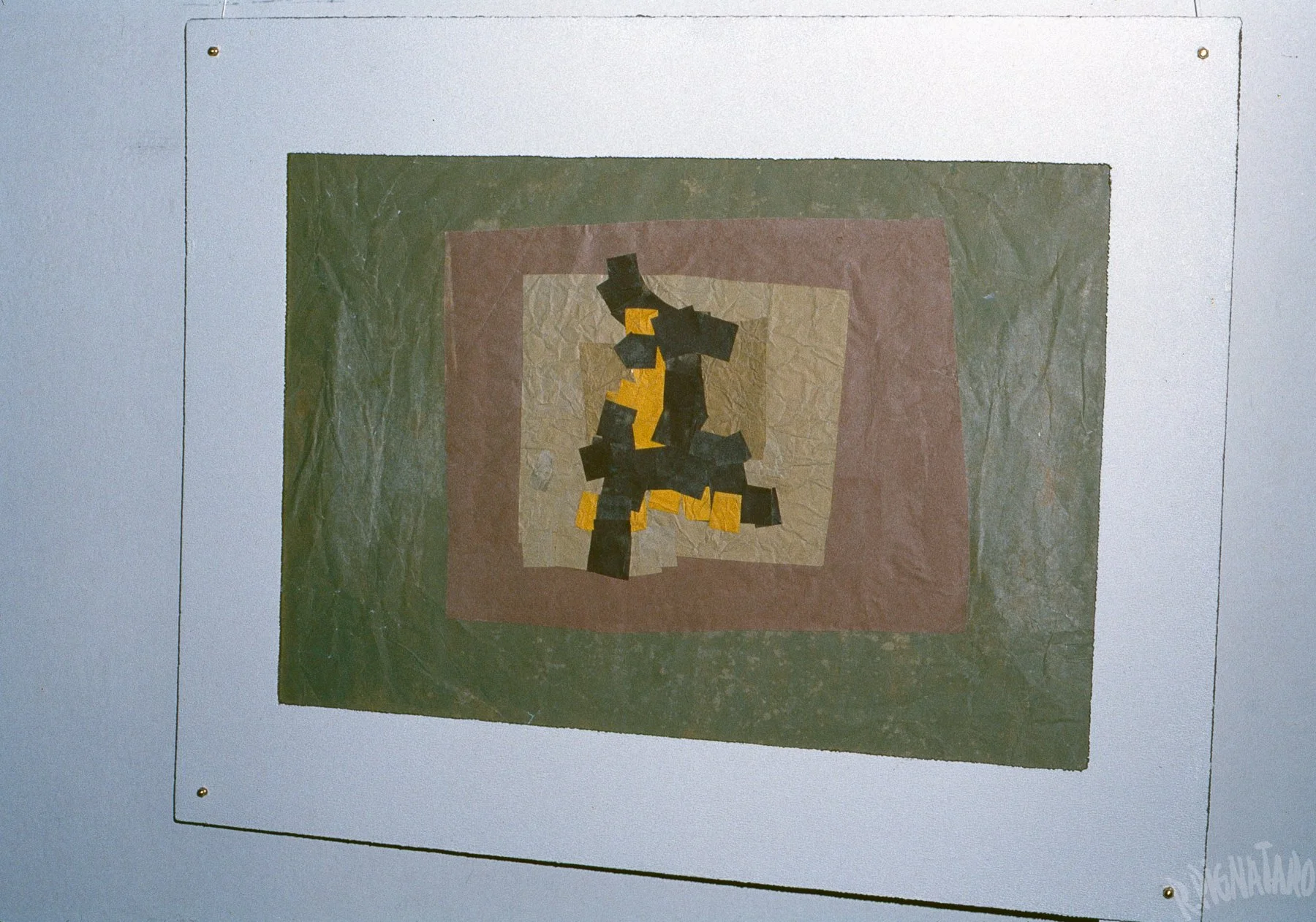
This approach to abstract storytelling had been developing for several years. A clear precedent appears in A Través de Estampas, Volumen II, published in 1974 (gallery below). There, repeated black and red paper fragments form compact scenes that suggest movement, tension, and interaction without telling a fixed story. Instead, the viewer is left to imagine what may be unfolding.


His interest in building meaning from repeated fragments was not limited to paper. In a series of small white works exhibited at Galería Lirolay in 1974 (gallery below), Pignataro explored a similar idea through oil paint, shaping and arranging small painted units into low-relief compositions. Although quieter and more restrained, the works share the same sense of rhythm, interaction, and forms coming together as if part of an unfolding visual sequence.


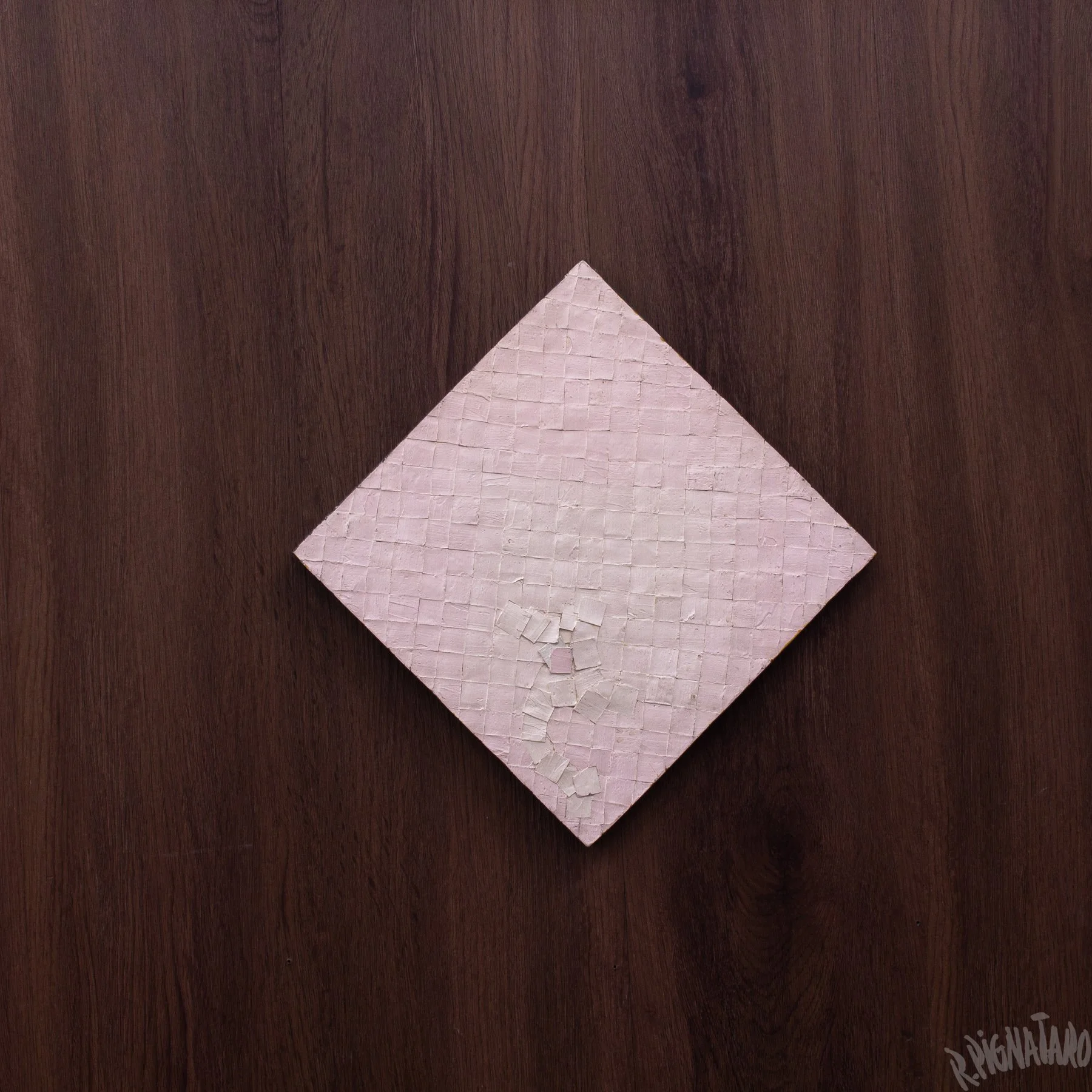


Before returning to the story, I wanted to give the reader a clearer sense of where Pignataro stood stylistically and conceptually by the mid-1970s, building art from repeated fragments, implied movement, and open-ended relationships.
•••
The Museum Re-enters the Conversation
While the Lirolay exhibition is underway, the museum makes one more attempt to revive the project—but still on altered terms.
Jun 17, 1977
In a letter signed by the museum’s director, Héctor Dante Cincotta, Pignataro is informed that the exhibition—originally scheduled for April—has been reassigned to a new slot, August 2–15, following a reordering of the program.
The project is back on the calendar—but still in its altered form, and months later than originally agreed.
Jun 28, 1977
Pignataro acknowledges Cincotta’s proposal, noting that the new date had already been anticipated in earlier communications.
He still declines. In the months since the original agreement, he had already committed his artistic ideas to the Galería Lirolay exhibition, and the new date left little room to produce new work. What had been feasible in April was no longer so in August. Just as importantly, the group-exhibition format still fell short of the solo presentation he had originally pursued.
Jun 30, 1977
Despite his refusal, Pignataro does not abandon the matter. He writes directly to Guillermo Whitelow, then director of the Museo de Arte Moderno de Buenos Aires, enclosing six slides from works recently shown at Galería Lirolay. The letter is brief and outwardly formal, but it marks an important turn: the issue has now reached the institution’s highest authority.
Aug15, 1977
A man identified as “Mr. Seffern” telephones Pignataro at the bank to arrange a meeting with Whitelow.
•••
On Whitelow’s Desk
By mid-August, Whitelow has agreed to meet. A final attempt to salvage the exhibition takes place.
Aug 18, 1977
Pignataro and Whitelow meet in person. According to Pignataro’s record of the interview, Whitelow does not seem fully informed about the details of the case and appears inclined to treat the matter as something best left behind.
Pignataro insists on a more precise point: that the exhibition had not been annulled because of the quality of his work, and that this should remain clear in the record. Whitelow reportedly acknowledges that the museum had handled the matter without direction, admits that the whole episode had been unjust, and agrees that the August offer had given Pignataro too little time to accept under the circumstances.
The meeting also exposes a deeper divergence. While repeatedly praising Pignataro’s painting, Whitelow explains that he does not generally favor solo exhibitions for “younger artists,” preferring instead group formats or retrospective structures. Pignataro, without dismissing the point entirely, makes clear that he does not see himself as a young artist in need of that kind of framing.
Whitelow adds that previously scheduled solo exhibitions would still go forward because, as he puts it, denying those artists their shows “would create a hardship for them by closing off the possibility of their exhibitions—and they would get a heart attack.”
Whitelow offers no solution for 1977. Instead, he promises to keep the matter in mind for the following year and suggests that, after the week of August 21–27, he might arrange to visit Pignataro’s work at home. The interview closes, once again, with recognition but no concrete resolution.
This is the last recorded exchange between Pignataro and the museum. By this point, the possibility of restoring the original exhibition had effectively collapsed. Although the show never came to fruition, the episode leaves us with a number of interesting reflections, which I explore below.
•••
Final Thoughts
One might ask: why dedicate an entire publication to an unrealized exhibition? One answer would be because it shows a side of an artist’s life often overlooked by historians—the uncertainty, the persistence, the setbacks. But that is not the main reason I wrote this article.
I find this story fascinating because of how well it reflects a familiar pattern of bureaucratic chaos and institutional malfunction that Argentineans have grown accustomed to endure in daily life, particularly in the XX century. People with good intentions and ideas often undermined by the very institutions meant to support them.
This story puts actual faces to this frustrating aspect of Argentine society, tracing a chain of individuals whose decisions, omissions, and failures of judgment pretty much ensure a bad outcome becomes inevitable.
First, Marta Grimberg, who, despite her evident good faith, failed to secure the exhibition in the program and, more importantly, failed to alert Pignataro as things began to unravel, leaving him stranded and the next administration to deal with the consequences. Then Guillermo Whitelow, who recognized the injustice of the situation but failed to correct it.
Don’t get me wrong. Both Grimberg and Whitelow are, by any measure, significant figures in the history of Argentine art, and anyone even slightly familiar with the period will recognize the breadth and influence of their trajectories. That is precisely why I find their handling of Pignataro’s case difficult to digest.
To Grimberg’s credit, the circumstances under which the merger began to unravel are hard to imagine, especially against the ominous backdrop of the military dictatorship. It is entirely possible that she herself was displaced abruptly, leaving her with little recourse to save the project.
As for Whitelow, my understanding extends only so far. While he did acknowledge the mishandling of the case and the harm done to Pignataro, the speed with which his exchange moves from sympathy to condescension and then to injury is hard to ignore. To describe Pignataro as a “young artist” at the age of forty-seven—after a twenty-year career and substantial critical recognition—already feels odd and reductive.
But the real blow lies in Whitelow’s lack of self-awareness when insisting that other artists could not be denied their exhibitions because, in his words, “they would get a heart attack,” while ignoring the fact that Pignataro himself had already been placed in exactly that position.
One might argue: Whitelow was now in charge, and he had every right to pursue a curatorial direction different from Grimberg’s, and that would be absolutely true. But the issue before him was not one of curatorial philosophy; it was the museum’s failure to honor a commitment that had already become materially consequential, even if the damage had originated under the previous administration.
Whitelow’s inability—or unwillingness—to recognize this revealed, in my view, not only poor leadership, but the moment when he let what remained of the institution’s integrity fully collapse. And while he did offer to “keep the matter in mind for the following year,” no documented follow-up survives, making it difficult not to see the promise as another deferral rather than a serious attempt at reparation. Even if the offer was sincere, the implication remained the same: Pignataro’s exhibition was a low-priority matter, something to be handled eventually, when convenient. He had every right to feel belittled by such a prospect and to move on.
As a final thought, despite the clear unfairness of the situation, I do believe Pignataro would have benefited from accepting the museum’s revised proposal, even if it fell short of the original commitment. In practical terms, it still would have given his work and his name a level of visibility that was difficult to obtain elsewhere. And yet, I understand why he refused. To forgo that kind of exposure on principle reveals something about his character that goes well beyond what the art alone can show.
Whitelow and Pignataro did cross paths again in later years, seemingly on good terms, which suggests that both men, at least personally, had moved on from the episode.
•••
About the Artist
Roberto Lucio Pignataro (1928–2008) was an Argentine abstract and informalist artist active in Buenos Aires from the 1950s through the early 1980s. His work explored non-representational visual language through painting, collage, assemblage, texture, material experimentation, and what might be understood as abstract storytelling.
Research Context
This article forms part of an ongoing archival project documenting Roberto Pignataro’s exhibitions, correspondence, institutional relationships, and artistic activity within the Buenos Aires art scene of the 1960s–1970s. It reconstructs an unrealized 1977 exhibition project involving the Museo Municipal de Artes Visuales, the Museo de Arte Moderno de Buenos Aires, Galería Lirolay, Marta Grimberg, Guillermo Whitelow, and the broader cultural context of Argentina during the military dictatorship.
Topics Covered in This Article
Roberto Pignataro, Argentine abstract art, Argentine Informalism, Buenos Aires art history, Latin American abstraction, Museo de Arte Moderno de Buenos Aires, Museo Municipal de Artes Visuales, Galería Lirolay, Teatro General San Martín, Marta Grimberg, Guillermo Whitelow, Héctor Dante Cincotta, museum history Argentina, Argentine art institutions, 1970s Buenos Aires art scene, unrealized exhibitions, artist archives, exhibition reconstruction, institutional failure in art history, art and bureaucracy, Argentine cultural history, art during the military dictatorship, abstract collage, paper collage, A través de Estampas, Dos Museos de Arte Moderno, Roberto Pignataro exhibitions, museum correspondence, Lirolay exhibitions, independent artists in Buenos Aires, archival research in Latin American art, historical reconstruction of exhibitions.