Roberto L. Pignataro - Biography
•••
Overview
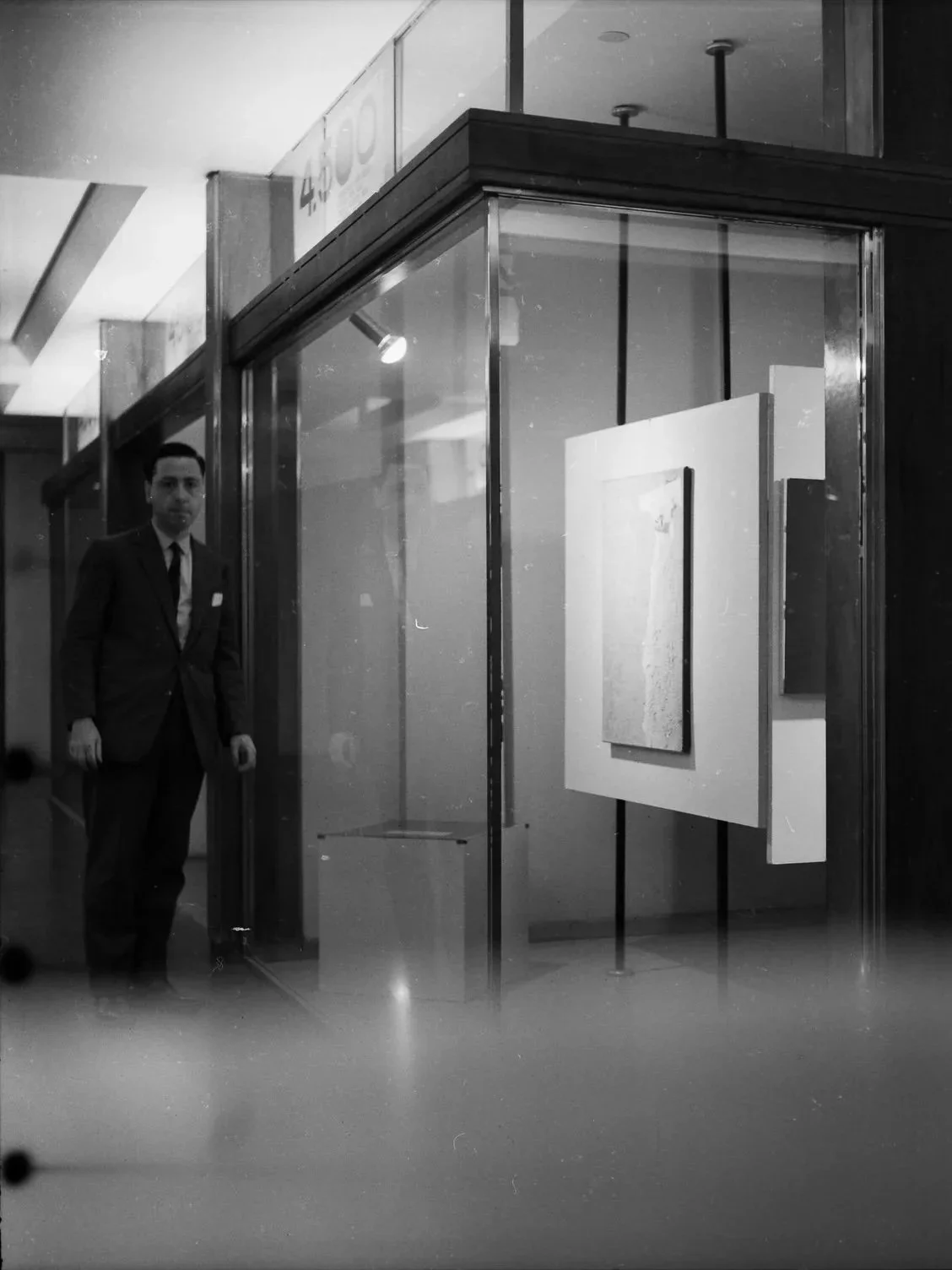
Roberto L. Pignataro. C. 1965
Roberto Lucio Pignataro was an Argentine abstract artist whose career was built through work, discipline, invention, and independence. Born in Villa Urquiza, Buenos Aires, in 1928, he developed a wide-ranging body of work that included painting, collage, assemblage, relief, artistic books, slide-based projects, and experimental exhibition formats.
For much of his adult life, Pignataro worked full-time at the Banco Central de la República Argentina. Far from preventing his artistic career, that job became one of the conditions that made it possible. It gave him the financial stability to remain independent from patrons, dealers, and fashionable circles. With his own resources, he financed books, framed and mounted works, designed and printed promotional materials for his exhibitions, organized shows, mailed portfolios internationally, and preserved his archive with unusual care.
His work belongs to the broader history of postwar Argentine abstraction and informalism, but it does not fit neatly into a single movement. Across several decades, Pignataro explored abstraction as a language of rhythm, structure, material presence, and wordless storytelling. His art asks for close looking: small formats, textured surfaces, layered materials, raised oil-paint forms, and sequences of images that suggest animation without spelling out meaning.
•••
Early Life and Family Background
Roberto Lucio Pignataro was born on September 21, 1928, in Villa Urquiza, Buenos Aires, to Salvador Pignataro and Ana Galli. His family world was deeply Italian-Argentine. His father was born in Acri, Cosenza, Calabria, while his mother’s family is remembered as having roots in Milan.
His childhood unfolded during one of Argentina’s most difficult modern decades. The 1930s, later remembered as the Década Infame, were marked by the aftershocks of the Great Depression, political instability, corruption, and social hardship. For families like Pignataro’s, those conditions were not abstract. Work could be scarce, security fragile, and economic stability something not to be assumed.
His father, Salvador, worked as a herrero y carpintero — a blacksmith/metalworker and carpenter — taking work wherever it was available. This meant that the family moved often, following job opportunities as circumstances required. Yet Pignataro did not remember childhood only through hardship. He also remembered soccer, cinema, tango, neighborhood life, and a family world marked by deep affection for his parents and his brother Francisco, known as Toti.
His father Salvador also became one of Roberto’s earliest practical influences. Through him, Pignataro absorbed a culture of tools, repair, construction, and manual problem-solving. That inheritance would later become visible throughout his artistic life. He was not only a painter, but a maker: an artist who built frames, prepared surfaces, cut mats, organized displays, and handled the physical demands of art with unusual confidence.
•••
Childhood Visual and Sensory Formation: Tango, Cinema, Comics, Theater, and Football
Before Pignataro encountered fine art through the academy, his childhood imagination had already been shaped by the popular culture of 1930s Buenos Aires. Tango was his primary musical exposure, part of the soundscape of family life, neighborhood life, radio, records, and the city itself. Alongside it came motion pictures, early Walt Disney animation, comic magazines, illustrated humor, theater, and football — each giving him ways of seeing, hearing, and feeling before he became a painter.
Family memories describe him as drawing constantly from an early age. This was not casual doodling so much as a steady effort to improve: observing, copying, refining lines, and testing ways to make figures, gestures, and scenes more convincing. Long before formal art school, drawing had already become a discipline.
Cinema and animation gave him a fascination with movement, transformation, gesture, rhythm, and visual sequence. Walt Disney’s early animated films were especially important as examples of drawn images brought to life through motion, timing, and character. Comic magazines such as Patoruzú and El Tony, along with the illustrated world of Dante Quinterno, introduced him to graphic economy, caricature, visual timing, and the ability of images to tell stories without relying heavily on words.
Tango added an essential emotional and rhythmic layer. It gave him an early experience of atmosphere, cadence, tension, melancholy, and movement — qualities that would later resonate in his abstract compositions, where forms often seem to pulse, drift, collide, or unfold like visual phrases. His later emails show how deeply he retained the sound-world of older Buenos Aires, including memories of patio dances, bandoneón music, and the “pure sound” of earlier generations.
Theater also entered his cultural formation early. In a later email, Pignataro recalled that between roughly 1939 and 1943, the four members of the Pignataro family attended performances at Teatro del Pueblo, then operating at Corrientes 1528, where they saw works such as Fuenteovejuna, El matrimonio, El inspector, El casamiento, and El mercader de Venecia. He remembered this as a valuable cultural stage for ordinary people, accessible for only a few coins before the political rupture of 1943 brought that chapter to an end.
Football added another visual language. His father, Salvador, introduced Roberto and his brother Francisco “Toti” to the sport early, taking them to Boca Juniors matches since the late 1930s. Pignataro became a lifelong Boca supporter, but the visual impact of football extended beyond fandom. Stadiums exposed him to the vivid color culture of Argentine football: jerseys, banners, crowds, rivalry, movement, and collective emotion. Those bold team palettes entered his visual memory and later surfaced in some of his paintings as part of the broader popular imagery he absorbed.
Together, tango, cinema, Disney animation, comics, theater, football, and the street gave Pignataro’s childhood an education in rhythm, movement, color, sequence, atmosphere, drama, and symbolic force. His later abstraction did not emerge from art school alone. It also grew from the popular culture that surrounded him: the music of Buenos Aires, the screen, the printed page, the stage, the stadium, and the city itself.
•••
Drawing as Refuge and Early Illustration
Pignataro’s early schooling was difficult. Family memory suggests that, as a young student, he struggled with learning difficulties that schools of the period were poorly prepared to handle. His progress was uneven, and teachers could be harsh rather than supportive.
Yet drawing gave him a place to shine. An elementary teacher reportedly noticed his ability and placed him in charge of illustrating history lessons on the blackboard. In a school environment where he did not always find confidence, drawing became both a talent and a refuge.
Before turning toward modern painting, Pignataro also worked on the side as a freelance cartoonist and illustrator while holding regular employment at the Central Bank. In the late 1940s and early 1950s, he published comic strips in local newspapers and produced graphic work for advertisements. This early experience remained important. Even after his work became fully abstract, it often retained a sense of visual sequence, compression, rhythm, and communication.
•••
Technical Training, Military Service, and the Central Bank
After a difficult experience in formal schooling, Pignataro did not follow a conventional academic path. His father, Salvador, seems to have understood where his son’s strengths lay and directed him toward a more practical form of education. As a teenager, Pignataro entered the Escuela de Aprendices Operarios de Marina at the Taller de Marina Dársena Norte, where he trained with a focus on carpentry and additional work in metal.
In that hands-on environment — learning tools, materials, construction, and workshop discipline — he began to shine in ways that traditional schooling had not allowed. This technical background reinforced the practical intelligence he had first absorbed at home: precision, construction, material handling, and problem-solving. It also helps explain the physical confidence that later marked his artistic practice. Pignataro was not only an image-maker. He was a maker in the fullest sense: someone comfortable building, cutting, mounting, framing, repairing, and inventing solutions with his hands.
That practical visual ability continued to be recognized. During his naval conscription in Bahía Blanca, a superior reportedly assigned him to illustrate physical-education manuals, turning his drawing skills toward instructional and technical use. The episode fits a larger pattern in his early life: whenever the setting became practical, visual, or manual, Pignataro found a way to stand out.
In 1948, at nineteen, Pignataro entered the Banco Central de la República Argentina. The Central Bank became one of the defining structures of his adult life. For decades, he sustained a double life: full-time bank employee and serious artist. His salary helped him support his parents, buy his own apartment and car, and eventually build a house in Punta Mogotes, Mar del Plata. He was never rich, but he belonged to a generation for whom middle-class salaried work could still build a life.
The bank also drew on another side of his mind: his mathematical and analytical ability. Pignataro was respected at work for his facility with numbers, reports, and complex information. That discipline complemented the precision and structural thinking he later brought to his artistic work.
•••
Art School and the Turn Toward Modern Painting
Pignataro’s move toward formal art education appears to have begun before his enrollment at Manuel Belgrano. A surviving document shows that in 1947 he enrolled at the Escuela Taller Argentina de Bellas Artes, under the direction of Gaspar Besares-Soraire. Little else is currently known about this episode, but it suggests that his interest in structured artistic training was already active during the late 1940s, while he was moving between technical formation, military service, illustration, and early working life.
In 1953, at twenty-four, Pignataro entered the Escuela Nacional de Bellas Artes Manuel Belgrano, attending classes at night after finishing his workday at the Banco Central. His initial goal appears to have been practical: to refine his abilities as an illustrator and draftsman. But art school redirected his ambitions.
At Manuel Belgrano and later at the Escuela Nacional de Artes Visuales Prilidiano Pueyrredón, he entered an unusually fertile educational environment. Among his notable teachers were Aurelio Macchi and Héctor José Cartier. He also shared formative spaces with figures who would become important names in Argentine culture, including Marta Minujín, Pérez Celis, and Raúl de la Torre.
That environment was defining. After days spent inside the formal world of the Central Bank, Pignataro entered classrooms where modern painting, abstraction, design, and visual theory were being actively debated. The experience shifted him from cartooning and applied illustration toward modern painting. He trained as a Dibujante Profesional, later as Maestro Nacional de Artes Visuales, and eventually obtained the title of Profesor de Pintura in 1961. By then, he was no longer simply sharpening illustration skills. He had entered the exhibition world of modern Argentine art.
His first important public recognition came in 1957, when his work La Corneta was selected for the cover of Radio Nacional’s magazine. The work marked an early threshold in his career: the illustrator was becoming a modern artist.
•••
Culture, Music, and Visual Thought
Pignataro was known to be erudite and culturally voracious. He studied art extensively and admired artists such as Leonardo da Vinci, Picasso, Braque, Miró, Mondrian, Chagall, Pollock, Rothko, Xul Solar, and Japanese masters. But his interests were never confined to painting. He could speak with equal depth about Shakespeare, cinema, theater, literature, philosophy, opera, tango, jazz, and football — moving naturally between high culture, popular culture, and the modern visual world.
Music was especially central. Pignataro was not simply a music lover; he was a melomaniac and audiophile who collected and catalogued recordings obsessively and invested in high-fidelity audio equipment. Tango was one of his deepest musical worlds, especially the music of early and mid-twentieth-century Buenos Aires. Figures such as Carlos Gardel, Aníbal Troilo, Julio De Caro, and Pedro Maffia belonged to the cultural memory he carried with him, not as nostalgia, but as part of a living language of rhythm, mood, discipline, and urban identity.
His musical world extended far beyond tango. He listened seriously to classical music, opera, jazz, African drums, and musicians ranging from Beethoven and Vivaldi to Louis Armstrong, Django Reinhardt, Miles Davis, and John Coltrane. More recent archival research has revealed another, previously undocumented dimension of these interests. A group of handwritten notes dating from around 1964 records works by composers and musicians including John Cage, Lou Harrison, Edgard Varèse, Luigi Nono, Pierre Schaeffer, Pierre Henry, Karlheinz Stockhausen, Henri Pousseur, François-Bernard Mâche, Ornette Coleman, Cecil Taylor, Eric Dolphy, and Charlie Parker.
The notes are particularly revealing because Pignataro did more than record names and titles. He also noted instrumentation, performers and conductors, magnetic tape, electronic sounds, loudspeaker placement, and other details concerning how particular works were constructed and experienced. They show an attentive interest not only in the music itself, but in the techniques and ideas behind some of the most unconventional music being produced and circulated during the postwar period.
Music, then, was not simply background sound for Pignataro. It was an organized field of study, pleasure, memory, and sensory exploration. Surviving writings also suggest that he thought about music in relation to his own creative process, particularly the freedom and improvisational logic he associated with modern jazz. Together, these records reveal a musical culture considerably broader than was previously understood and offer new context for the importance of rhythm, structure, atmosphere, experimentation, and sensory experience throughout his visual work.
He also had an extraordinary memory, something that comes through in a series of emails he sent to his son Daniel later in life. In those messages, Pignataro often returned to the Buenos Aires of his childhood and youth with almost documentary precision. They read like the recollections of someone who had spent a lifetime actively observing and absorbing the world around him — art, music, streets, buildings, family stories, public rituals, popular culture, and the small details through which a life and a city are remembered.
•••
Zen, Proportion, and the Viewer
Pignataro developed a sustained interest in Japanese Zen culture and Eastern philosophy, reflected not only in his own recollections but also in the books that survived from his personal library. Among them are works by D. T. Suzuki, Kakuzō Okakura, Eugen Herrigel, and Hubert Benoit, as well as a Spanish edition of the I Ching. Together, they demonstrate an engagement that went well beyond passing curiosity, encompassing Zen philosophy, aesthetics, psychology, ritual, and broader ideas of balance, transformation, and perception.
These readings help provide context for qualities that repeatedly appear in his work: synthesis, restraint, silence, spatial balance, suggestion, and an interest in allowing relatively simple elements to carry complex relationships. They do not explain his art by themselves, but they form part of the intellectual background against which many of those choices can be understood.
He was also deeply absorbed by the regla de oro — the golden proportion, or golden ratio — the classical principle of harmony often associated with Renaissance ideas of balance, order, and proportion. For Pignataro, it was not a rigid formula, but a way of sensing whether an artwork possessed inner structure and visual resonance. This helps explain his fascination with Leonardo da Vinci, whom he admired not only as a master artist, but as a figure who united beauty, structure, intelligence, science, and proportion.
These interests also help illuminate his relationship with viewers. In the Argentina of the 1960s, many artists used manifestos, public gestures, political rhetoric, and verbal frameworks to guide how their work should be received. Pignataro often moved in the opposite direction. He preferred the image to act first, leaving space for the viewer to encounter the work without being told in advance what to see or how to interpret it.
•••
Abstraction as Wordless Storytelling
One of the central threads of Pignataro’s career was the idea that abstraction could suggest movement, mood, and narrative without naming a subject. His early exposure to cinema, animation, and comics gave him a sensitivity to visual sequence. His interest in Zen reinforced silence and suggestion. His admiration for proportion gave him a belief in hidden structure.
In 1968, he self-published A Través de Estampas, a wordless book of sequential abstractions. The project reflected his conviction that abstract images could unfold like a silent visual narrative, allowing meaning to emerge through the viewer’s own encounter with the images.
In 1972, he published En Slides Color, a pocket-sized album of 35mm slides intended for projection. The project combined abstraction, photography, reproduction, and circulation, allowing images to travel beyond the physical gallery space.
In 1974, he published A Través de Estampas Vol. II, returning to sequential abstraction in an even more concentrated form. Together, these projects show an artist deeply interested in how abstract images could move through time, space, and different viewing technologies.
The dream of animation never fully left him. Throughout the 1970s and early 1980s, Pignataro acquired filming equipment with the hope of producing animated films, a goal that reached back to his childhood fascination with cinema, animation, comics, and motion pictures. The project proved difficult to realize: animation required space, time, equipment, money, and sustained technical labor that were hard to reconcile with full-time work, family responsibilities, and Argentina’s inflationary economy.
In the mid-1990s, personal computers finally gave him a practical way to return to that old ambition. He learned Macromedia Director and produced a small group of short animations, some abstract and others more traditionally figurative. They were made more as a personal pursuit than as a formal art project, but they fulfilled a dream that had accompanied him since childhood: to make images move.
•••
Exhibitions and Alternative Circulation
From the late 1950s through the late 1970s, Pignataro sustained an active exhibition career in Buenos Aires, showing at traditional venues including Galería Peuser, Galería Van Riel, Galería Lirolay, and others. But some of his most original gestures happened outside the conventional gallery model. Again and again, he looked for ways to keep his work moving — through rotating displays, printed materials, books, slides, and mail campaigns.
One of his most distinctive solutions was the rotating art display in public spaces. Beginning with the long-running Florida y Lavalle project of 1965–1967, and later continuing through related formats at Galería Arax and Galería Embassy, Pignataro repeatedly returned to the idea of placing works in visible, accessible settings where the public could encounter them outside the usual rhythm of a formal gallery exhibition.
These displays were modest in scale but ambitious in concept. They allowed him to keep his work in circulation, test different arrangements over time, and bring abstraction closer to the everyday movement of the city.
Pignataro also developed alternative forms of circulation through the mail. Beginning in the mid-1960s and continuing through the 1970s, he sent color slides, books, photographs, and promotional materials to critics, museums, galleries, universities, and cultural institutions in Argentina and abroad. His self-published books and slide projects were part of the same strategy. They allowed abstract images to travel beyond the exhibition wall and reach viewers who might never encounter the original works in person.
These efforts reveal Pignataro at his most characteristic: practical, imaginative, persistent, and independent. He did not wait for ideal conditions. He used the tools available to him — storefronts, printed matter, photography, postal networks, and slide technology — to create his own channels of visibility.
•••
Material Invention and Mature Work
By 1970, Pignataro’s work had reached a remarkable level of material invention. At Galería Lirolay, he presented paintings whose surfaces were built from small extruded forms of oil paint — dots, ovals, triangles, crescents, and other raised elements that transformed painting into a micro-sculptural field.
These works invited close looking. Their scale, texture, and surface complexity resisted quick consumption. Critic César Magrini reportedly spent more than thirty minutes silently viewing the works before later publishing an admiring review. The episode captures something essential about Pignataro’s mature art: it asked for patience, proximity, and physical presence.
His work during these years moved through collage, assemblage, relief, textured painting, and increasingly complex surface construction. Critics, family members, and viewers often found it difficult to classify because Pignataro kept developing original visual languages that did not fit neatly within existing categories. Yet the works were not obscure or forbidding. They could be structurally complex while remaining clear, balanced, and inviting to the eye.
•••
Miami and the International Horizon
In 1970, Pignataro’s ambitions extended beyond Argentina through an exhibition at the Miami Museum of Modern Art. The project was logistically difficult and emotionally costly, involving shipping problems, bureaucratic delays, strained correspondence, and the challenge of organizing an international exhibition from Buenos Aires while working full-time and supporting a growing family.
Yet the exhibition took place. It remains one of the clearest examples of his international ambition and of the fragility of independent artistic efforts carried out across distance, language, and institutional systems. It was both a success and a wound: proof that his work could travel, and evidence of how much such efforts demanded from an artist without institutional backing.
•••
Later Exhibitions and Shifting Priorities
By the late 1970s, Pignataro’s public exhibition activity began to slow. His last official solo exhibition took place in 1979, but this did not mark an immediate withdrawal from public presentation. Rather, it began a quieter final phase in which he continued to show existing works through more modest, self-directed formats.
After 1979, he rented a small window space at Galería Embassy, located at Marcelo T. de Alvear 640 in Buenos Aires, where he organized a rotating retrospective display. Every few weeks, he presented a different existing work, continuing his long-standing interest in public-facing, alternative exhibition formats. The project remained active until 1986, after which he no longer exhibited his work publicly.
In 1982, Pignataro also participated in the collective exhibition Collages with two existing pieces. The exhibition placed him alongside major figures of Argentine art, including Antonio Berni, Emilio Pettoruti, Marta Minujín, Clorindo Testa, and Carlos Alonso. Even in this quieter final phase, his work remained in dialogue with the broader Buenos Aires art scene.
The reasons for this shift were practical as much as artistic. Argentina’s unstable economy made exhibitions increasingly difficult. At the same time, Pignataro and his wife were raising two growing children, and family life demanded more time, attention, and resources. The death of his father, Salvador, in 1980 added a personal loss to an already difficult period. His reduced exhibition activity should therefore not be read simply as artistic retreat. It reflected the collision of economic conditions, family responsibilities, personal loss, and the burden of sustaining an independent art career without institutional backing.
Pignataro retired from the Central Bank in 1986, after nearly four decades of service. By then, his public exhibition activity had come to an end, but his creative life did not. He continued, albeit more sporadically, organizing his archive and pursuing his interests in music, film, technology, and visual experimentation. In the mid-1990s, personal computers finally allowed him to return to a childhood dream of animation, producing a small group of short works in Macromedia Director — a private continuation of his lifelong interest in images, movement, and sequence.
•••
Archive and Legacy
Pignataro left behind a body of work that resists easy classification: paintings, collages, assemblages, reliefs, artistic books, and slide-based projects that expanded abstraction through material invention, visual sequence, and close engagement with the viewer. Across these forms, he developed a language that was intimate in scale, structurally inventive, and rooted in the belief that abstraction could carry rhythm, mood, and meaning without becoming literal.
He also documented his career with unusual care and detail for an independent artist of his time. He preserved exhibition records, correspondence, photographs, press clippings, mailing lists, promotional materials, books, slides, and other traces of his artistic activity. That archive makes clear that his career was more substantial than his later public profile might suggest. He was not an artist working in obscurity. Critics noticed him, viewers engaged with his exhibitions, institutions responded to his mailings, and his work appeared in press coverage from the early 1960s through the late 1970s. His choice to remain independent gave him unusual autonomy, but it may also have limited his access to the kind of sustained institutional framing that preserves an artist’s reputation over time..
His career also belongs to a particular moment in Argentine modernity. By the mid-twentieth century, Argentina’s expanding middle class, public education system, urban cultural infrastructure, and increasingly available technologies had opened possibilities that would have been harder to imagine a generation earlier. Pignataro used those possibilities with unusual intelligence. Public art schools, affordable supplies, photography, printing, typewriters, postal networks, art venues, bookstores, slide technology, and a middle-class salary all became part of the practical infrastructure that allowed him to sustain an independent artistic life.
What made him unusual was not simply that these tools were available, but how fully he turned them toward his art. He used them to exhibit, publish, document, promote, circulate, and preserve the work without depending on patronage or institutional sponsorship. The system he built mattered because it served the art — extending its reach, protecting its record, and leaving behind the evidence needed to understand it.
What survives today is therefore both the work and the archive that surrounds it: paintings, collages, assemblages, books, slides, photographs, correspondence, exhibition records, press clippings, and family memory. Together, they reveal an artist who transformed the tools of an ordinary life — salary, craft, memory, study, family responsibility, and persistence — into a sustained artistic project.
•••
Sources and Archival Basis
This biography is based on the Roberto Pignataro family archive, including artworks, exhibition records, correspondence, photographs, press clippings, artistic books, slides, and emails sent by Roberto Pignataro to his son Daniel after Daniel moved abroad.