Introduction
Despite his extensive career, Roberto Pignataro maintained a notably discreet presence within the Argentine art scene, rarely attending his own shows, never issuing public statements, and avoiding the kind of personal publicity so common among art figures of the 1960s.
While he kept himself out of the spotlight, his work was regularly noted and discussed in the press.
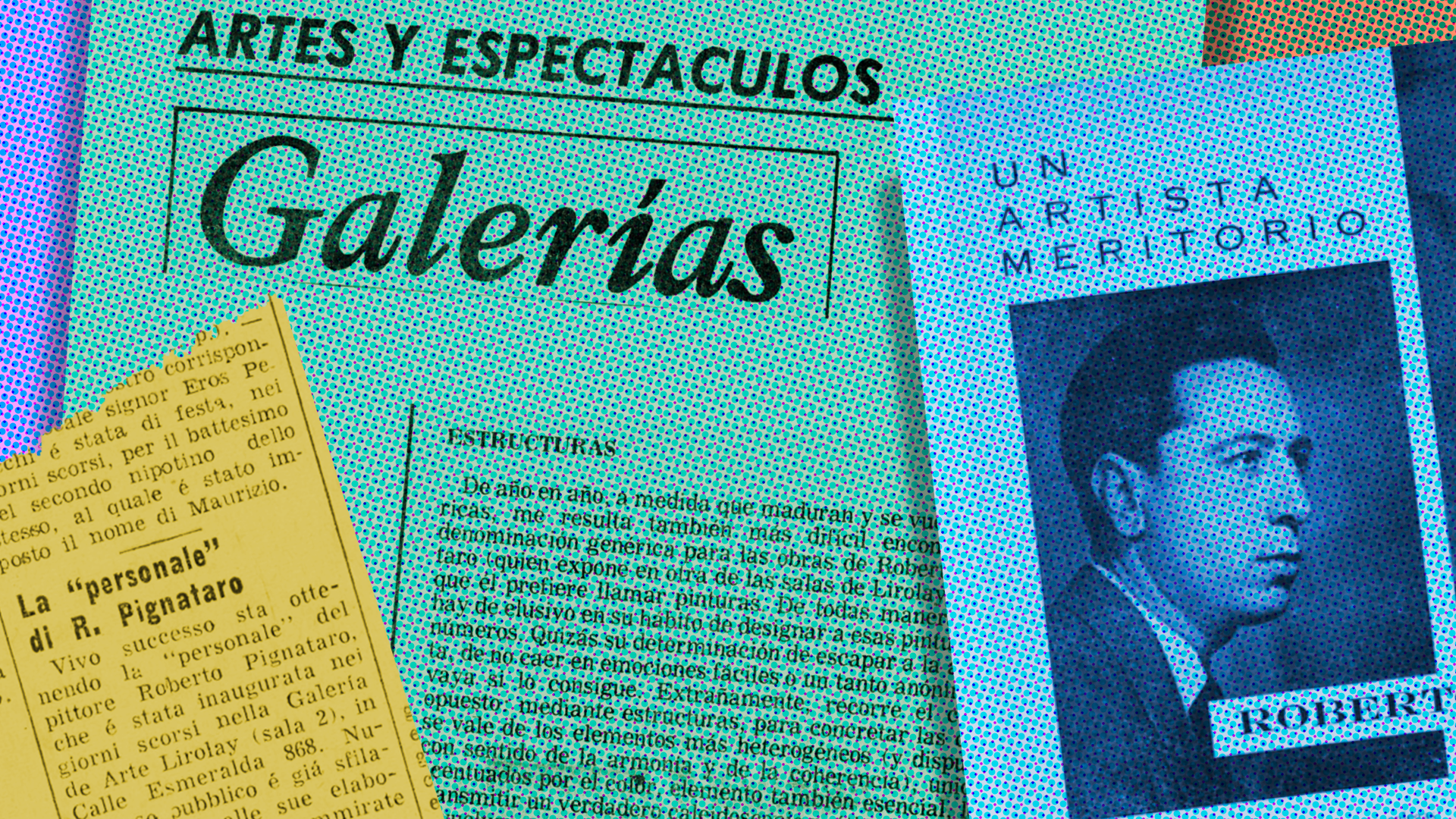
This article compiles a collection of newspaper clippings from those years, tracing how critics responded to his work and how they situated him within the artistic landscape of the time.
1961 — La Prensa — Hugo A. Parpagnoli — Galería Lirolay
Excerpt from the column Artes Plásticas (group exhibition review).
H. A. Parpagnoli. “Artes Plásticas — Tres Exposiciones.” La Prensa (Buenos Aires), July 13, 1961.
•••
“Three years after his first solo exhibition, the young Argentine painter R. Pignataro now occupies a room at the Peuser Gallery, 750 Florida Street, with a group of oil paints marked by broad, firm brushwork. Signs resembling numbers and letters, gathered or moving across the surface of the picture, make up the graphic material that gives the painter occasion to build thick textures and to test his considerable power of synthesis. According to the demands of a traditional way of seeing, the works numbered 232 and 112 offer a harmonious whole.”
Hugo A. Parpagnoli
1964 — La Razón — Hernández Rosselot — Van Riel Gallery Exhibition
Hernández Rosselot. “Premios en la Bienal Cordobesa.” La Razón (Buenos Aires), October 3, 1964, Notas de Arte — Cuadros y Exposiciones.
•••
“Roberto Pignataro brings together several qualities — human and artistic — harmonized in a true symbiosis. He does not possess the arrogance of false creators and is a painter of great sensitivity in color and a distinctive imagery. His surname places him within Latin tradition, and yet the way he organizes color and space recalls an Eastern lyricism. He works in oil and collage with virtuosity; there are no chromatic stridencies, the material is not abundant (he works on paper), and he achieves precise values — combinations in which the vigor of impasto and a defined image are blended with pictorial subtlety.
Since 1957, when he held his first solo exhibition — Radio Nacional honored him by reproducing one of his works in full color on its program — from those figurative works to his current lyrical abstractions (horizontal and vertical), he has pursued his practice quietly: without resorting to national salons, without participating in prizes, yet exhibiting regularly since completing his studies at the Academy of Fine Arts. The eleven works he presents in Room V of the Van Riel Gallery reveal an accomplished artist with enormous faith in what he does. He has already overcome the opposition between technique and expression, and for that very reason his language communicates beyond the material that sustains it.”
Hernández Rosselot
1965 — La Razón — Hernández Rosselot — Museo de Arte Moderno
Excerpt from the review “Ocho Escultores en el Museo de Arte Moderno,” a survey of multiple artists.
“Notas de Arte — Cuadros y Exposiciones: Ocho Escultores en el Museo de Arte Moderno.” La Razón (Buenos Aires), July 31, 1965
•••
“We highlight the eighth exhibition Roberto Pignataro presented at Peuser, where his restless search becomes evident through expressive material or the incorporation of everyday objects, producing unusual foreshortenings that reveals a studious artist.”
Hernández Rosselot
1966 — Buenos Aires Herald — Bonnie Tucker — Galería Estímulo de Bellas Artes
Bonnie Tucker, “Round the galleries,”Buenos Aires Herald (Buenos Aires), Saturday, July 23, 1966.
•••
“Paintings now on display at Galería Estímulo de Bellas Artes show that while Argentina may have her consecrated lions, she also has many promising young artists.
(…)
Meanwhile, ingenious cork disk collages by Roberto Pignataro represent an interesting and effective experiment in texture. Sensitively arranged, these original works display unusually balanced compositions and surprising but pleasing colour combinations of browns, creams and mauves.
Pignataro’s collages, a new and legitimate artistic innovation, are well worth seeing.”
Bonnie Tucker
1968 — Corriere degli Italiani — Galleria Lirolay
“La ‘personale’ di R. Pignataro.” Corriere degli Italiani (Buenos Aires), May 13, 1968, p. 4.
•••
R. Pignataro’s “Solo Exhibition”
“Recently inaugurated at the Lirolay Art Gallery (room 2), Roberto Pignataro’s solo exhibition has been met with strong public interest. Visitors have gathered around his richly worked canvases—widely admired for their bold use of form and color—which once again reveal an uncommon command of material and a creative impulse that feels continually renewed.
Critics have likewise taken note of the exhibition, reaffirming the favorable assessments they had already expressed about the artist on earlier occasions. The show will remain open through Saturday the 18th.”
1969 — El Cronista Comercial — César Magrini — Galería Lirolay
Excerpt referring to Roberto Pignataro from the column Crónica de un Caminar (II).
“Crónica de un Caminar (II).” El Cronista Comercial (Buenos Aires), October 7, 1969, p. 7.
•••
“Spring has settled into Lirolay (a name that itself sounds like spring…). It is a pity to have to compress so many sensations. At Paraguay 794, first floor, they are offered room by room, each with a different face.
Here, his name is Roberto Pignataro: an explosion of color, original textures, paintings made of a curious material used with fervor and imagination, works identified by numbers — 1168, with splendid reliefs and a stormy red; 1159, like a spiderweb meant to trap happiness, edged with the most delicate gold, its surface carved by love and by a fountain of fantasy; 1153 — suddenly a dream bursts open, little clouds appear where the last memories remain suspended, held by balsams of tears; 1120, with a marvelous underlying structure, something even the most imaginative Eastern miniaturists could scarcely have conceived; 110, a calling card of spring in full splendor (I told you it was here), a painting precious and sweet like the sonnets of Petrarch or Garcilaso, where structures play freely within the form; 1135, beyond words, before which I would feel like dancing, like the Jongleur de Notre Dame told by Anatole France and set to music by Massenet; 1109, like a mosaic in which one can read the past and the future — but not the present, which must be guessed.
Pignataro is something of a dreamer within this garden of miracles — do not forget him. Seek out his paintings: more than paintings, they are fantasy itself, captured in a moment of happy distraction.”
César Magrini
1970 — El Cronista Comercial — César Magrini — Galería Lirolay
César Magrini, “Apprentice Sorcerer.”El Cronista Comercial (Buenos Aires), no. 20,590, “Galleries” section, September 1970.
•••
Apprentice Sorcerer
“At Lirolay, one has just seen a tightly arranged exhibition — small in physical space yet expansive in what it held — of works by Roberto Pignataro.
To define it is extremely difficult: like an illuminated child, he has chosen for his compositions the most unusual materials — fragments of glass in various colors; the purest and most pliable magic enclosed within a single chromatic range that nevertheless, by its very vitality, is capable of producing all tones; tiny pieces of (perhaps) ceramic, which he combines like fantastic fleurs-de-lis, like variegated and mysterious fruits — the reign of the finest charm, of the most total and contagious suggestion.
Pignataro, who seems by nature elusive and withdrawn (the small card announcing the exhibition says simply, “Roberto Pignataro in recent paintings,” and I recall an excellent previous show of his), has now turned — with astonishing results — to mastering a material that in other hands would be foreign to painting and to art, and that can only approximately be defined as “assemblage.”
Of course, he does not stop there; but his character — which can be guessed or intuited from what’s on display, and in the fact that he has not titled his works, only mere numbers (a sign, this, of a sincere intellectual rigor, and one that also helps to situate him) — flourishes widely in his pictures. Yes, pictures — because they immediately awaken in the viewer sensations of the most refined beauty, and on a level of incorruptible honesty.
“1275” bursts into a multitude of tiny scales in red, pink, or gray; color unifies, elevates, and composes a work that had already been composed beforehand by the surest intuition.
Delightful is “1220”, where white alternates with a soft grayish blue, and where a radiant and utterly pure white band reincorporates the essence of the most stripped-down painting.
“1285” — little stones from a hidden world, each of them of precious and defined form; an immaculate, strongly original work, with pinks, with ochres, with a pronounced red, with some fleeting white.
“1255” — tiny pieces of glass, carved by some fairy in the deepest pages of a storybook, on a background that also seems taken from the garden of fantasy, and in which even the frame collaborates, expressly designed for the ensemble.
“1226” — total relief, with a sparkling vein of color, blood and life of the work.
“1270” — with minute prisms, gray, and a brief lattice where ochre and pink rest.
“1262” — with a tooled, warm surface, lower areas white and very lively grays.
“1227” — caramel color of childhood, and something like a suggested central sun.
And “1259” — squares that enclose all the mysteries one might wish to imagine, and a central circle, lacework of the imagination.
Someone deep and profoundly original, with a language of his own — lofty, poetic. Someone whose works one ought to see more often, because they rescue us from so much monotony, so much flatness, so much painful poverty as that which daily besieges us.”
César Magrini
1971 — La Razón — Hernández Rosselot — Galería Lirolay
Hernández Rosselot, “Durero Criollo: Grabados a Precio Justo.”La Razón (Buenos Aires), December 18, 1971, “Notas de Arte — Cuadros y Exposiciones,” p. 8.
•••
“Roberto Pignataro once again continues along what for him has become a defined path — informalist painting, imbued with a certain Eastern spirit. On this occasion, using oils and handmade paper, he composes a series of beautiful abstract images in subtle and restrained tonal ranges. Among the various works he exhibits at the Lirolay Gallery, we especially highlight those numbered 476, 491, and 497, for the strong presence of these noted qualities.”
Hernández Rosselot
1971 — El Cronista Comercial — César Magrini — Galería Lirolay
César Magrini, “Música Mayor en Tonos Menores.” El Cronista Comercial (Buenos Aires), December 21, 1971, p. 20.
•••
Major Music in Minor Tones
“For some time now I have followed with great interest the trajectory of Roberto Pignataro, who has just presented his latest and most recent works at Lirolay. In his eagerness — in his constant eagerness to search for new forms of expression — he now turns to a very subtle, very delicate combination that may recognize its roots in certain refined schools of the East: oil and tissue paper. He achieves effects of great seduction, of assured beauty, in an authentic and very happy celebration of the spirit, one that openly triumphs in these works where the utmost care in execution, always impeccable, does not relegate to the background another element, equally central and multiple, that characterizes him: inspiration, talent, and the broadest and freest creative faculty.
And perhaps to affirm that he is not willing to abandon the strong conceptual rigor that has always illuminated and guided all his production, Pignataro continues to prefer numbers rather than words for the titles of his works — an attitude that at the same time opens the door to an interpretation that escapes the “opus” by which musical works are ordered, and instead might suggest a certain inclination toward the cabalistic.
In truth, these works — aside from such speculations — stand there to confirm a presence made of poetry, lightness, and an immaterial, transparent play: “462” rises in warm reds, while “476” is a proclaimed hymn of purity; music and sweetness prevail in “492,” and the colors calm themselves gently in “483”; a very fine play of tonal appearances animates “497,” and the hinted exoticism of “484,” with its exquisite areas of collage, joins the rest of the work in a soft harmony. Finally, “450” opens with the same magnificent patience of a tree that grows until it spills into the richest foliage — image, in turn, of the entire work of this sensitive artist, Roberto Pignataro.”
César Magrini
1972 — El Cronista Comercial — César Magrini — Galería Lirolay
César Magrini, “Estructuras.” El Cronista Comercial (Buenos Aires), December 11, 1972, p. 4.
•••
Structures
“Year after year, as they mature and grow richer, it becomes increasingly difficult for me to find a generic label for Roberto Pignataro’s works (now on view in another room at Lirolay), which he himself prefers simply to call paintings. In any case, there is something elusive in his habit of designating them only by numbers — perhaps a determination to escape anecdote, to avoid easy or somewhat anonymous emotions. And indeed, he achieves this.
Strangely, he proceeds by the opposite route: through structures. To realize them he employs the most heterogeneous elements (arranged with a sense of harmony and coherence), united or accentuated by color — itself an essential element — and thus conveys a true poetic kaleidoscope: forms that envelop the viewer with their seduction and lyricism, rare sensations and games in which matter is merely incidental, the purest and firmest manifestation of the spiritual.
And, as always, magnificently made, in a dazzling and highly seductive counterpoint.”
César Magrini
1979 — El Cronista Comercial — César Magrini — Galería Lirolay
César Magrini, El Cronista Comercial (Buenos Aires), September 4, 1979, p. 19.
•••
“Final stop at the Lirolay Gallery (Paraguay 794). As always, a largely youthful and heartening gathering. Roberto Pignataro himself embodies that spirit — his quiet and lengthy labor has not achieved (and it is an injustice) the recognition he so fully deserves. His works are curious, rare, unique. He employs assemblage techniques (threads of subtle contour, fragments of heterogeneous materials), unified through color — gentle, restrained, harmonious. They are difficult to describe in words alone: one must see them, feel them, and then, inevitably, admire them.”
César Magrini
About the Artist
Roberto Lucio Pignataro (1928–2008) was an Argentine abstract and informalist painter active in Buenos Aires between the 1950s and early 1980s. His work explored texture, material presence, and non-representational visual language across painting, collage, and assemblage.
Research Context
This article forms part of an ongoing archival project documenting exhibitions, press reception, and artistic activity surrounding Pignataro and the Buenos Aires art scene of the 1960s–1970s.
Topics Covered in This Article
Press coverage of artists, newspaper art criticism Argentina, media reception of abstract art, Roberto Pignataro press reviews, critics and artistic reputation, documenting historical art reception, art journalism 1960s–1970s, how artists were perceived in their time, contemporary reviews of exhibitions, archival research in art history, evolution of critical opinion, reputation building in the art world, artist visibility without self-promotion, interpreting historical criticism, Argentine cultural press history, reconstructing artistic legacy through media, critics on abstraction, reception of informalist painting, press archives and art history research, historical perception of modern art